Separate an interview from a study
The archived topic points to Rich Willy and PodChatLive episode 40. The episode page is a discussion reference, not a new experiment performed for MichaelT. Follow an actual paper when evaluating a research claim and preserve its authors and dates. This editorial worksheet is not written by the guest and does not claim that the complete video was transcribed or clinically reviewed.
Extract the actual comparison
The linked systematic review appeared online in 2019 with a 2020 issue date and compares motorised treadmill and overground running biomechanics. Record its eligible population, running conditions and measured outcomes from the paper. Keep those criteria attached to the result. A question about healthy adults under specified running conditions is not automatically a question about an injured person’s rehabilitation or every kind of treadmill.
Read differences as well as similarities
The review reports broad comparability across many measures while identifying differences for particular outcomes. Do not shorten that into exactly the same or always safer. Keep outcome-specific evidence and uncertainty visible. This page does not reproduce a gait-retraining programme, prescribe speed or incline, select shoes or calculate a tissue-loading limit for a runner.
State the conclusion you cannot draw
Before sharing a claim, write which decision the evidence actually informs and what it does not test. Personal pain, injury risk and return-to-running questions need appropriate qualified assessment. A podcast discussion and a systematic review can help frame a question without supplying an individual treatment plan or proving that one training surface is universally best.
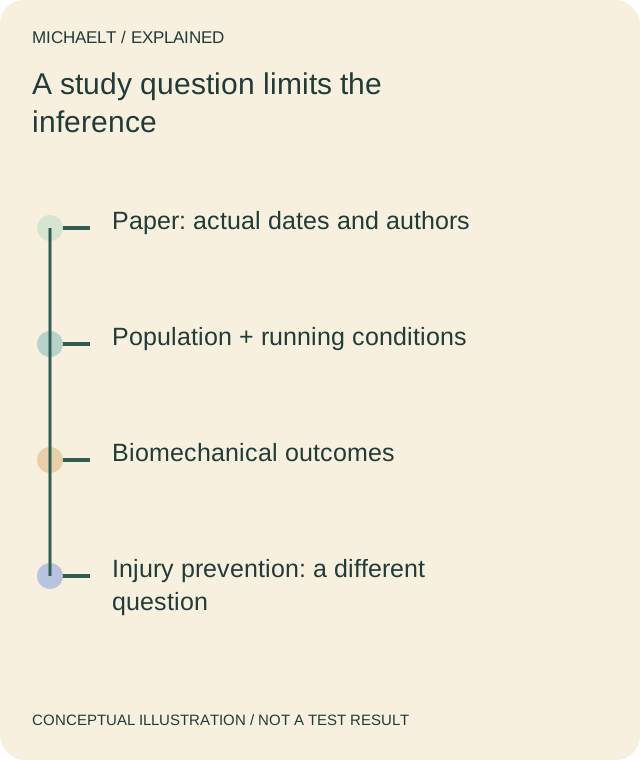
Read the drawing as text
Population, conditions and outcomes define the comparison. A biomechanical result does not automatically answer a personal injury-prevention question.
Work through an example
A fictional reading note asks whether an observed biomechanical comparison proves a treadmill prevents injury. It records the study question as biomechanical comparison, then marks injury prevention as a different conclusion not established by that question alone. No patient outcome, new meta-analysis or training recommendation is created.
Illustrative example; figures, people and organisations in the worked record are fictional.
The example record
Reference
- Evidence
- 2019 online / 2020 issue
- Boundary
- Keep real dates
Comparison
- Evidence
- Motorised treadmill / overground
- Boundary
- Specified conditions
Outcome
- Evidence
- Biomechanical measures
- Boundary
- Read individual results
Personal inference
- Evidence
- Injury-prevention claim
- Boundary
- Not established here
Download blank worksheet (.csv) ↗Download worked example (.csv) ↗
Keep your own record
Use the result within its scope
Read the complete paper and obtain appropriate clinical advice for individual concerns. This is an evidence-reading procedure, not a diagnosis, running prescription or new work attributed to Rich Willy.
Reference sources
- PodChatLive: episode 40 with Rich Willy ↗
- Systematic review: treadmill versus overground running, 2020 ↗