Identify the authority and the event
Record the place where the vehicle is to be registered and the exact event: dealer purchase, private purchase, renewal, move from another jurisdiction or another case. Start at the relevant official vehicle authority, not an article copied from another state. California DMV is linked here as a named US example, not a substitute for the requirements elsewhere. Keep the date on which you checked the official instructions.
Turn the official route into a document index
Follow the authority’s route for that transaction and list the documents it actually requests. For each, record the issuing party, whether you have the original or a copy, and any unanswered question about format or signatures. Use neutral document identifiers in a shared tracker. Do not put a full vehicle identifier, identity-document scan, address or account credential into a public example.
Keep responsibilities and timing explicit
Record who must supply or submit each item and which official instruction gives the applicable timing. Do not copy a universal deadline from this worksheet: buyer, seller and renewal duties may differ. If a dealer or agent handles part of the process, ask what receipt or confirmation you will receive and what remains your responsibility. An appointment is not proof that registration has been completed.
Reconcile the result
After following the official process, keep the actual submission receipt and reference privately. Compare the issued information with the documents supplied and ask the authority how to correct any discrepancy. Mark pending items separately from accepted ones. A payment receipt alone may not resolve every document or eligibility question. Ask the authority directly about an unusual transaction rather than improvising a missing document.
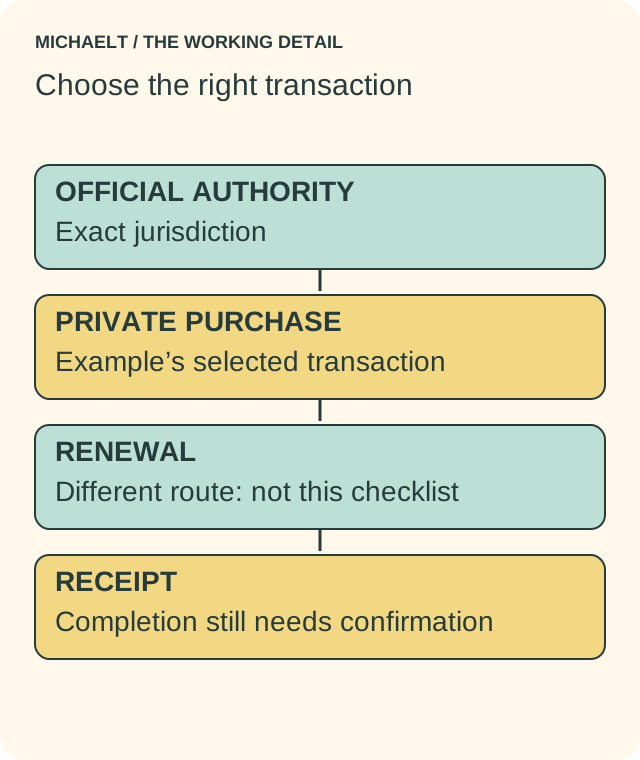
Read the drawing as text
Start with the official authority, then select private purchase rather than renewal for the example. Build the document list from that route and keep actual completion pending.
Work through an example
A fictional owner starts with California private purchase, then discovers that the saved checklist concerns renewal. The tracker rejects that checklist as the wrong transaction and links to the DMV’s purchase route. Document D1 is held; D2 is awaiting clarification from its issuer. The worksheet records no fee, legal deadline or successful registration for a real vehicle.
Illustrative example; figures, people and organisations in the worked record are fictional.
The example record
Jurisdiction
- Illustrative value
- California example
- Evidence needed
- Official DMV route
Transaction
- Illustrative value
- Private purchase
- Evidence needed
- Not a renewal checklist
Documents
- Illustrative value
- D1 held / D2 question
- Evidence needed
- Exact requested form and issuer
Completion
- Illustrative value
- Pending
- Evidence needed
- Actual authority confirmation
Download blank worksheet (.csv) ↗Download worked example (.csv) ↗
Keep your own record
Use the result within its scope
Fees, required documents, deadlines and road-use permissions come from the current official authority for the actual case. This tracker organises the enquiry; it is not legal advice or an application submitted on your behalf.
Reference sources
Earlier articles on this subject
- What Do You Need To Register A Car? ↗ — 2021-10-28, Maria Baldwin.