Define the record’s purpose
Use the diary to describe an ordinary sleep pattern for an appropriate professional discussion. NHLBI’s dated sleep guide includes a sample diary; it is a recording aid, not a current individual treatment plan. If a clinician supplies a specific form, follow that form. This page does not prescribe sleep restriction, change medicines or tell you to delay care for worrying symptoms.
Record times with their meaning
Keep going to bed, trying to sleep, final waking and getting out of bed as distinct events when known. Record estimates honestly and include the date across midnight. A clock interval between bedtime and rising is time in bed, not a direct measurement of sleep. Avoid treating a wearable’s stage label as a clinical diagnosis or silently combining it with a person’s recollection as one measurement.
Keep uncertainty and context visible
Record estimated awake periods and relevant ordinary context only to the extent useful for the appointment. A missed entry is missing data, not a night with zero sleep. Do not remain awake to monitor yourself, provoke a symptom or change your usual care merely to improve the diary. Keep personal routines and health details private.
Review observations with the right person
Bring the actual entries, their uncertainty and your questions to the clinician’s appropriate secure route. A small set of nights cannot establish why someone feels tired or whether an underlying condition is present. Ask which further information is needed rather than assigning a disorder or target score yourself. A diary can support care while remaining an estimate of experience.
Read the drawing as text
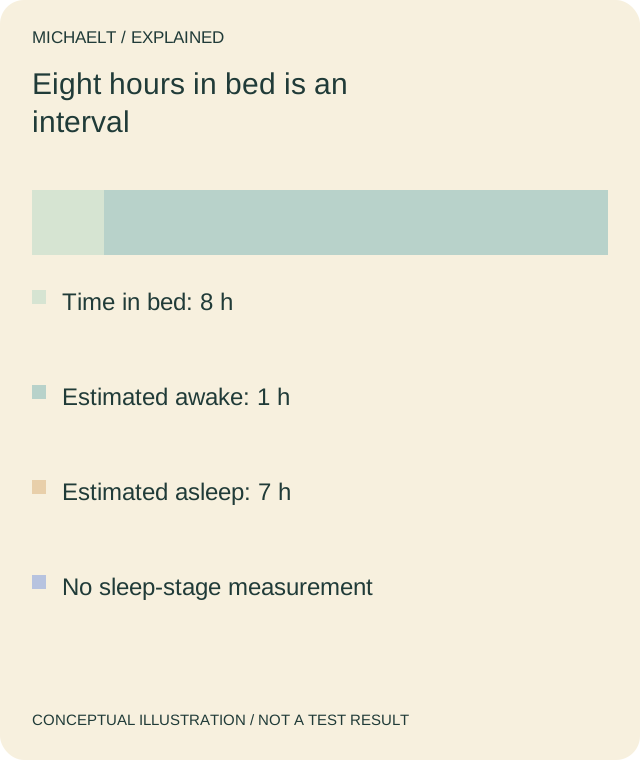
The fictional eight-hour interval contains one estimated awake hour and seven estimated asleep hours; no sleep stages or disorder are measured.
Work through an example
A fictional person records 23:00 to 07:00 in bed: 8 hours. Their combined estimate of time awake within that interval is 1 hour, giving an estimated 7 hours asleep. The arithmetic does not verify sleep stages, explain fatigue or diagnose insomnia. Both the clock interval and uncertainty remain visible.
Illustrative example; figures, people and organisations in the worked record are fictional.
The example record
In bed
- Illustration
- 23:00–07:00
- Meaning
- 8-hour interval
Awake estimate
- Illustration
- 1 hour in that interval
- Meaning
- Recollection
Sleep estimate
- Illustration
- 8 − 1 = 7 hours
- Meaning
- Not an instrument result
Interpretation
- Illustration
- Discuss actual diary
- Meaning
- No diagnosis
Download blank worksheet (.csv) ↗Download worked example (.csv) ↗
Keep your own record
Use the result within its scope
Use appropriate clinical advice for sleep concerns. This arithmetic example is neither a recommended schedule nor an assessment of the amount of sleep an individual needs.
Reference sources
Earlier articles on this subject
- What Are The Causes of Deep Sleep Disorder? ↗ — 2022-07-07, Maria Baldwin.