Name the test rather than the promise
Record the exact service, test name, device and instructions. Ask whether it measures a narrow visual task, checks an existing prescription or forms part of a clinician-led service. These are different claims. A result displayed as a percentage does not explain what was examined. Keep the provider’s original wording and avoid turning a marketing description into a diagnosis.
Check the stated conditions
Read eligibility, setup, correction and device requirements in the actual instructions. Record what could not be met instead of adjusting distance, screen settings or answers to obtain a preferred score. Do not use this worksheet to perform or calibrate a test. If instructions are unclear, ask the provider. A published validation of one named test does not validate every app or every user population.
Ask about the missing examination
The American Optometric Association distinguishes online vision tests from comprehensive eye care. Ask which eye-health assessments the service includes and which it cannot perform remotely. Keep a visual-acuity result separate from an assessment of all possible eye conditions. A reassuring screen score cannot rule out disease or explain pain, sudden change or other concerning symptoms.
Choose the appropriate next contact
Keep the actual result and limitations for discussion with a qualified eye-care professional. Seek timely professional help for symptoms; do not wait to finish an online comparison when vision changes suddenly or symptoms are urgent. Use the appropriate urgent-care route for your location. No app, clinic or prescription service is endorsed here, and this page collects no health data.
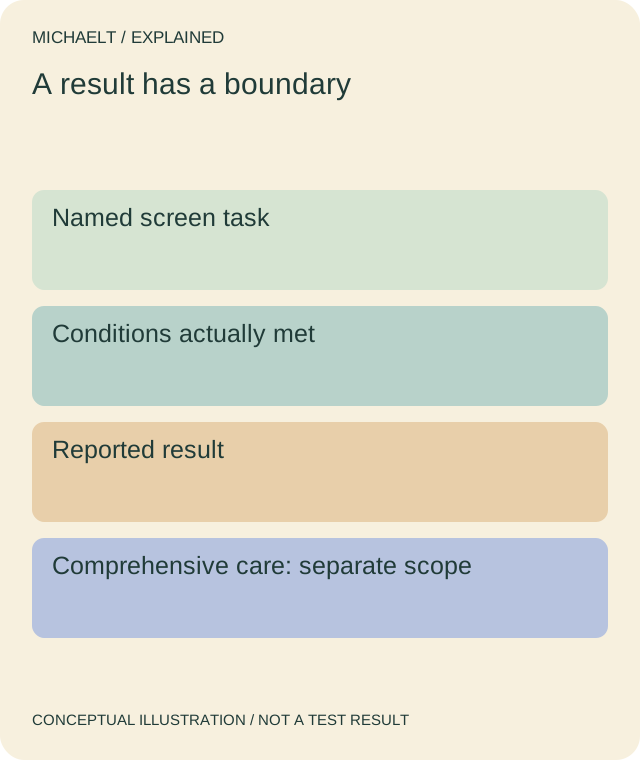
Read the drawing as text
A screen task and its result stay inside the stated conditions; comprehensive eye care is a separate scope.
Work through an example
A fictional service reports completion of a letter-reading task, but its description does not claim a comprehensive eye-health examination. The record stores the task and leaves eye-health assessment unconfirmed. The user asks a qualified professional about the correct appointment rather than interpreting the score as proof that every aspect of vision is healthy.
Illustrative example; figures, people and organisations in the worked record are fictional.
The example record
Task
- Record
- Named letter-reading task
- Limit
- Not every eye function
Conditions
- Record
- Provider instructions retained
- Limit
- No home calibration supplied
Eye health
- Record
- Scope unanswered
- Limit
- No disease exclusion
Next contact
- Record
- Qualified professional
- Limit
- Symptoms take priority
Download blank worksheet (.csv) ↗Download worked example (.csv) ↗
Keep your own record
Use the result within its scope
Use the record to clarify the service, not to diagnose yourself or decide a prescription. The appropriate examination depends on the individual and the clinician’s assessment.
Reference sources
Earlier articles on this subject
- The Benefits of Online Eye Tests ↗ — 2022-01-22, Maria Baldwin.