Identify the product and authority
Record the product name, country context, lot code and exact date wording from the actual package. Avoid translating every phrase into expiry. The linked USDA explanation concerns US food labels; meanings and legal requirements differ elsewhere. Infant formula and other specific products need their actual rules. Do not apply a general infographic over a product-specific instruction or local food-safety requirement.
Separate three kinds of date
Keep the printed date, the date you opened the package and any instruction about use after opening in different fields. Retain storage directions and whether the relevant conditions were known. A blank opening-date field is uncertainty, not evidence that the package is unopened. If handling or storage is uncertain, consult the appropriate official food-safety guidance rather than inventing a safe extra number of days.
Read the name and ingredients
For a product described with a familiar ingredient, read its actual statement of identity and ingredient list. FDA’s honey guidance illustrates why honey and a product containing added ingredients require accurate labelling. A photograph of a bottle or the word natural cannot establish its full contents, purity, allergen suitability or nutritional value. Keep those questions separate from a date interpretation.
Make the unresolved question explicit
Use a private note or shopping comparison to identify the missing instruction, then ask the manufacturer or appropriate authority through its verified route. Do not taste a doubtful product, use smell as proof of safety or perform a home adulteration test to fill this record. The worksheet does not give storage temperatures, preservation recipes or permission to eat food after a safety-related date.
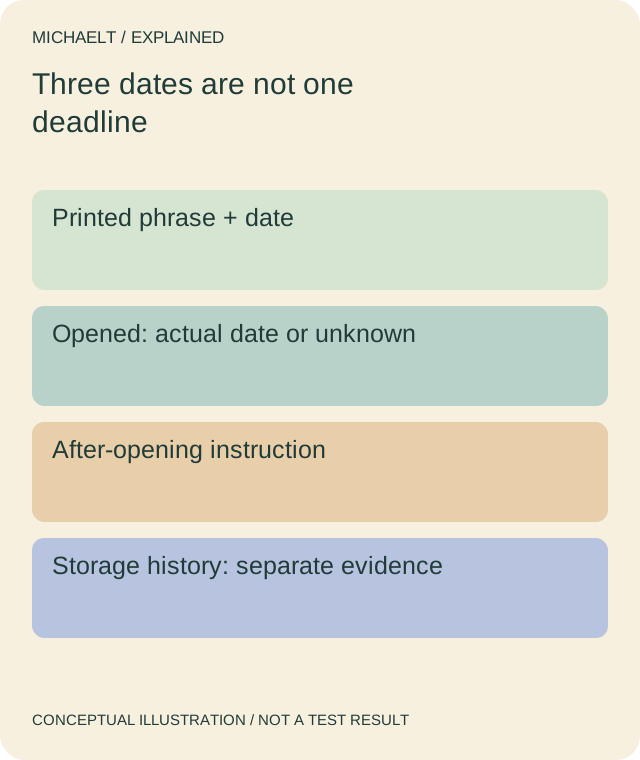
Read the drawing as text
The printed date, opening date and after-opening instruction answer different questions; none repairs an unknown storage history.
Work through an example
A fictional package has a printed best-quality phrase and a separate use-after-opening instruction. The person remembers opening it but not when. The record preserves both instructions and marks opening date unknown. It does not replace that uncertainty with the printed date or infer that an attractive appearance makes the food safe.
Illustrative example; figures, people and organisations in the worked record are fictional.
The example record
Identity
- Record
- Exact product / lot
- Meaning
- Package-specific
Printed date
- Record
- Exact wording retained
- Meaning
- Read local meaning
Opened
- Record
- Date unknown
- Meaning
- Do not guess
Storage/use
- Record
- Actual directions retained
- Meaning
- Safety not determined here
Download blank worksheet (.csv) ↗Download worked example (.csv) ↗
Keep your own record
Use the result within its scope
Follow current food-safety advice and the actual product instructions. This record clarifies labels; it does not test food or set a universal safe storage period.
Reference sources
Earlier articles on this subject
- Signs of a Good Quality Cooking Oil ↗ — 2021-06-11, Maria Baldwin.
- What Makes Organic Honey Better For Your Health? ↗ — 2021-07-20, Maria Baldwin.
- Know About Organic Tea ↗ — 2021-06-09, Maria Baldwin.
- Meal Replacement Powder: How to Choose the Right One ↗ — 2021-01-18, Maria Baldwin.
- What You Need To Know When Shopping For Meat ↗ — 2022-07-12, Maria Baldwin.