Start with the person’s preferences
Ask the person who will use the service what matters to them and who they want involved in the enquiry. Record practical preferences, communication needs and the questions they want answered. Do not infer a required care level from age, a marketing photograph or a relative’s convenience. Assessment of care needs and individual suitability belongs with the relevant qualified people and the person’s own decision-making arrangements.
Translate included into named services
Request the actual dated service list and terms for each option. Ask who provides a service, when it is available, what is included in the quoted price and which conditions or additional charges apply. Accommodation, transport, meals, scheduled visits and clinical services should have separate rows. A title such as independent living, assisted living or nursing home cannot on its own establish the complete contents of a particular package.
Make availability a question, not an assumption
Ask how the provider explains ordinary availability, out-of-hours contacts and changes in the service arrangement. Do not turn an unspecified help available phrase into continuous supervision or an emergency guarantee. Record the provider’s answer and any applicable document. Where local registration or inspection information is relevant, ask the appropriate public authority about the actual provider. A family visit is useful evidence of that visit, not an inspection of every service.
Review a complete comparable version
Compare the same period, room or service basis and distinguish mandatory from optional costs. Leave a missing answer visible. Ask what changes if needs or preferences change and which process governs that decision. Keep the person’s private health and financial information out of a public worksheet. Do not rank facilities or assume a particular funding, insurance or public-benefit entitlement from this comparison.
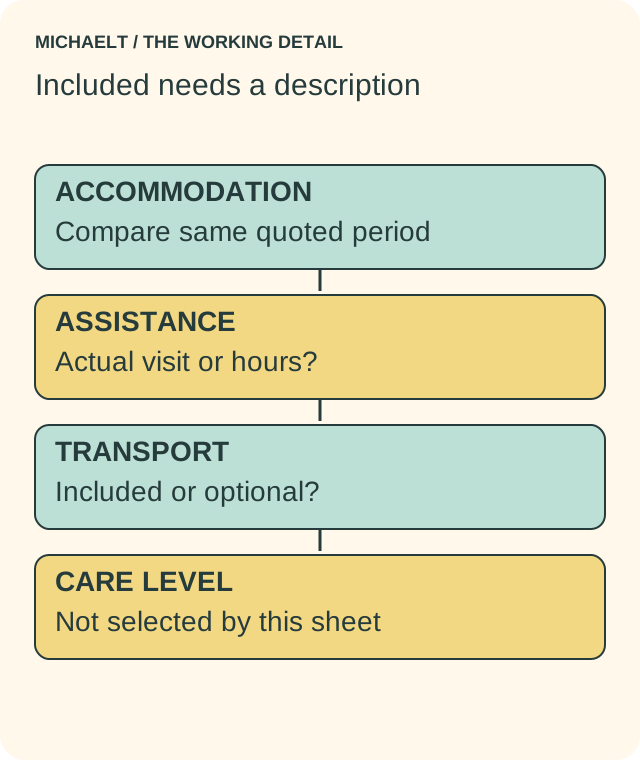
Read the drawing as text
Compare named service lists: accommodation period, scheduled assistance, transport and change process. Unspecified hours stay unknown; no care level is selected.
Work through an example
Two fictional service lists both say support available. A lists a scheduled visit; B leaves the hours unspecified. The comparison records the exact wording and asks B to clarify. Transport is included in A’s quoted scope but optional in B’s. No level of clinical care, fall prevention or better quality of life is inferred from these rows.
Illustrative example; figures, people and organisations in the worked record are fictional.
The example record
Quoted basis
- Illustrative option A
- Named accommodation period
- Illustrative option B
- Same basis to confirm
Scheduled assistance
- Illustrative option A
- Visit stated in service list
- Illustrative option B
- Hours not stated
Transport
- Illustrative option A
- Included in quoted scope
- Illustrative option B
- Optional: terms requested
Change process
- Illustrative option A
- Written explanation requested
- Illustrative option B
- Written explanation requested
Download blank worksheet (.csv) ↗Download worked example (.csv) ↗
Keep your own record
Use the result within its scope
Use actual provider documents and appropriate professional and public-authority advice. This is an enquiry about service scope, not a care assessment, clinical plan, eligibility decision or endorsement of a facility.
Earlier articles on this subject
- Senior Independent Living Is Beneficial For Seniors ↗ — 2022-04-21, Maria Baldwin.
- Get A Safe And Secure Environment For Seniors ↗ — 2022-03-21, Maria Baldwin.
- Benefits Of Home Health Care That Will Change Your Life ↗ — 2022-06-28, Maria Baldwin.
- Choosing the Right Nursing Home ↗ — 2021-09-23, Maria Baldwin.