Inventory only accounts you control
List the services you legitimately use and whether the number is a sign-in name, recovery contact, message destination or another factor. Use neutral account references in the working list. Do not store passwords, one-time codes, backup codes or full identity documents in it. This procedure is not a way to create anonymous accounts or receive another person’s authentication messages.
Use each provider’s official controls
Reach the account through its verified sign-in route and read the current recovery-contact instructions. Keep recovery contacts separate from other authentication and notification settings; changing one field may not update all uses. This site does not change your settings. Avoid links supplied in unsolicited messages and use the appropriate provider help if you cannot access an account.
Allow for the stated transition
Google’s recovery guidance notes that a new recovery number can take up to seven days to take effect. That is a provider-specific condition, not a universal waiting time for every service. Record the actual change date, confirmation and remaining transition questions for each account. Do not cancel a number merely because a form appeared to save a new value.
Confirm the intended recovery route
Follow the provider’s supported verification process without deliberately locking yourself out or disabling protections to test it. Keep the actual result and remaining dependency visible before arranging retirement through the phone provider. Ask about any unresolved account first. Revoking a number’s future use does not erase every historic message or record, and this sheet promises no protection against every account-recovery attack.
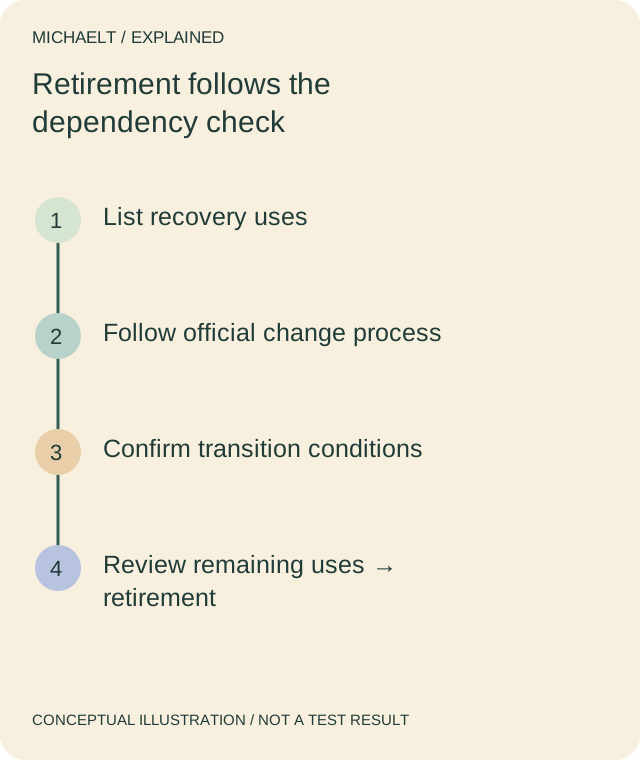
Read the drawing as text
Saving a new contact is not necessarily the end of a transition. Check each legitimate account’s actual process before retiring the old number.
Work through an example
A fictional inventory has account A using the old number for recovery and account B using it only for notifications. A’s official process has a transition condition, so its row remains pending even after B is updated. The record contains dates and states, not actual numbers, codes or credentials.
Illustrative example; figures, people and organisations in the worked record are fictional.
The example record
A: recovery
- Evidence
- Official change process
- State
- Transition pending
B: notifications
- Evidence
- Separate setting checked
- State
- Own confirmation
Secrets
- Evidence
- Not stored in this sheet
- State
- No codes or passwords
Number retirement
- Evidence
- Dependencies reviewed first
- State
- Provider process remains separate
Download blank worksheet (.csv) ↗Download worked example (.csv) ↗
Keep your own record
Use the result within its scope
Use current official account instructions and appropriate assistance for access problems. This is a dependency checklist, not an authentication bypass or a guarantee of recovery.