

Define the enquiry and authority
Record the jurisdiction, date of death and the professional question you need answered. Establish who is entitled to contact organisations and handle documents before sharing information. This worksheet is an index, not a grant of authority. The linked GOV.UK guidance gives one England-and-Wales starting point; do not import its probate process into another country or assume every estate needs the same application.
Separate assets and debts
Give each known account, property item or debt a neutral reference and identify the relevant organisation. Keep a possible item separate from a confirmed balance. The GOV.UK guidance asks for values at the date of death; a current account screen or today’s property advertisement answers a different question. Ask the professional which valuation basis and supporting document are actually required.
Track requests instead of inventing figures
For each reference record what was requested, the verified recipient, date, response and document location. Follow the organisation’s secure process for identity and authority documents. Do not put full account numbers, death certificates or beneficiaries’ details in a public worksheet. If an organisation has not replied, record pending rather than zero. Preserve the original reply and its date.
Hand over the open questions
Prepare a document index and a short list of uncertainties for the adviser. Reconcile repeated references before adding totals so an asset is not counted twice from two statements. Leave ownership, joint interests, valuation, tax, debts and distribution decisions to the appropriate process. A complete-looking spreadsheet cannot establish legal entitlement or permit withdrawing money from an account.
Read the drawing as text
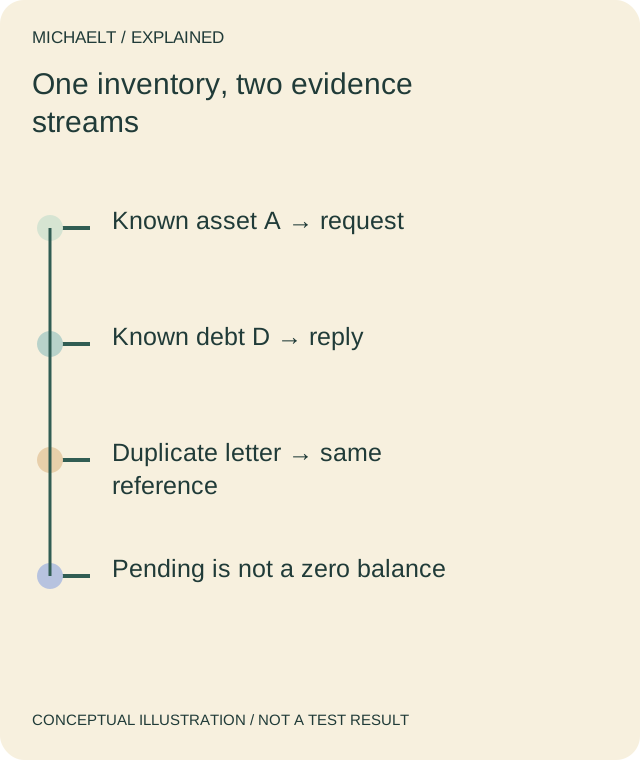
Assets and debts retain separate identifiers. Responses update an existing item; an unanswered request is not a zero balance.
Work through an example
A fictional inventory lists bank reference A with a date-of-death value requested and debt reference D with a reply received. A second bank letter concerns the same A, so it becomes a second document under A rather than another asset. The adviser receives the index with A still pending; no amount or inheritance outcome is invented.
Illustrative example; figures, people and organisations in the worked record are fictional.
The example record
Scope
- Document state
- Jurisdiction and authority to confirm
- Question
- Who may make the enquiry?
Asset A
- Document state
- Value requested
- Question
- Date-of-death basis
Debt D
- Document state
- Reply received
- Question
- Professional checks treatment
Handover
- Document state
- Two documents for A
- Question
- Avoid duplicate counting
Download blank worksheet (.csv) ↗Download worked example (.csv) ↗
Keep your own record
Use the result within its scope
Keep the private originals accessible to the authorised professional. This procedure supports an enquiry; it does not calculate inheritance tax, decide whether probate is needed or allocate an estate.
Reference sources
Earlier articles on this subject
- Reasons Why You Should Invest In Probate Lawyers ↗ — 2021-05-26, Maria Baldwin.