Ask what contribution is actually wanted
Start with the family or designated organiser’s wishes. Ask whether a reading, recorded music, live playing, silence or no contribution is preferred. Offer a small specific choice rather than assuming that every ceremony needs a speech. Record who can approve the words or selection and who should receive practical questions. The organiser’s cultural and religious arrangements take precedence over a generic timetable.
Separate selection from practical delivery
For a reading, keep the approved text and version with the reader’s name. For music, identify the exact work or recording, relevant start and end points and the person responsible for playback or performance. Similar titles can identify different recordings. Ask the venue about its actual facilities, applicable permissions and any restrictions; do not infer a licence or available equipment from this guide.
Build the cue into the ceremony
Ask when the contribution occurs, who introduces it, how the reader or musician is cued and where the next transition goes. A short running order is easier to use than a long thread of messages. If a time slot is agreed, time the approved contribution in the intended way and record that observation. Do not promise that every future reading will have precisely the same duration.
Agree an unpressured fallback
Ask whether another person should hold the text or whether the contribution may be omitted if the participant cannot continue. Keep the decision with the organiser and participant. For recorded audio, arrange the venue’s agreed check of the exact file and equipment. Avoid a last-minute substitution drawn from an unapproved playlist. Keep personal dedications and family contact details private unless publication is expressly intended.
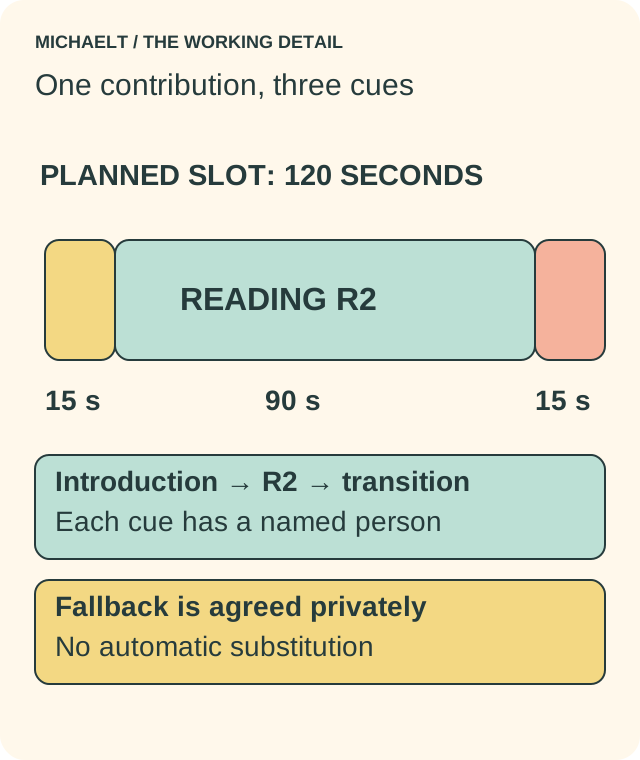
Read the drawing as text
Illustrative running order: 15 seconds introduction, 90 seconds reading R2, 15 seconds transition. Total planned slot: 120 seconds. Fallback is agreed privately.
Work through an example
An illustrative contribution starts with an introduction lasting 15 seconds, followed by a 90-second reading and a 15-second transition: a planned two-minute slot. The text is version R2, approved by the organiser. A second reader holds a copy, but takes over only under the agreed arrangement. These are invented timings for planning, not a report of a real ceremony.
Illustrative example; figures, people and organisations in the worked record are fictional.
The example record
Introduction
- Planned duration
- 15 seconds
- Responsible person
- Designated organiser
Reading R2
- Planned duration
- 90 seconds
- Responsible person
- Agreed reader
Transition
- Planned duration
- 15 seconds
- Responsible person
- Next cue holder
Fallback
- Planned duration
- As agreed privately
- Responsible person
- No automatic substitution
Download blank worksheet (.csv) ↗Download worked example (.csv) ↗
Keep your own record
Use the result within its scope
Keep a single approved version at the venue and with the contributor. Do not attach claims about closure, healing or the right date for a funeral to this practical document. Its purpose is to remove avoidable uncertainty from one contribution.
Earlier articles on this subject
- Reasons To Choose A Graveside Service Graveside services touch many people in different ways, and for good reason. They offer a sense of closure for the deceased and their loved on ↗ — 2022-07-28, Maria Baldwin.
- A Brief Introduction On Funeral Services In Singapore ↗ — 2022-08-02, Maria Baldwin.