Ask the person what they want
Start with the listener’s preferences and whether they want a music activity at all. Offer a manageable choice rather than assuming a favourite genre from age, diagnosis or a gift advertisement. The Alzheimer’s Association suggests familiar enjoyable music and letting the person choose where possible. That supports a respectful activity; it does not establish a treatment outcome for an individual.
Prepare a controllable source
Check that you can choose, pause and stop the music without an unexpected interruption. Consider the actual person’s comfort, communication and existing support arrangements. Avoid competing sound and an unnecessarily loud volume, following appropriate care guidance. This sheet gives no prescribed listening dose, clinical protocol or universal playlist. Do not buy an item or subscribe to a service merely because a past article called it therapeutic.
Make space for a change of mind
Ask or observe whether the person wants to continue, choose something else or stop, using their normal communication and support. Do not force a recollection, quiz them about lyrics or treat a quiet response as failure. A person can enjoy listening without reporting a memory. Keep the activity subordinate to their comfort and the actual responsible care arrangement.
Leave a modest next-visit note
With appropriate consent, note a preference useful for another visit, such as a chosen track or a wish for silence. Keep private health information out of a public playlist or photograph. Describe what was actually chosen rather than claiming improved cognition or reduced symptoms. A short social activity can be worthwhile without becoming a test of dementia or a substitute for professional care.
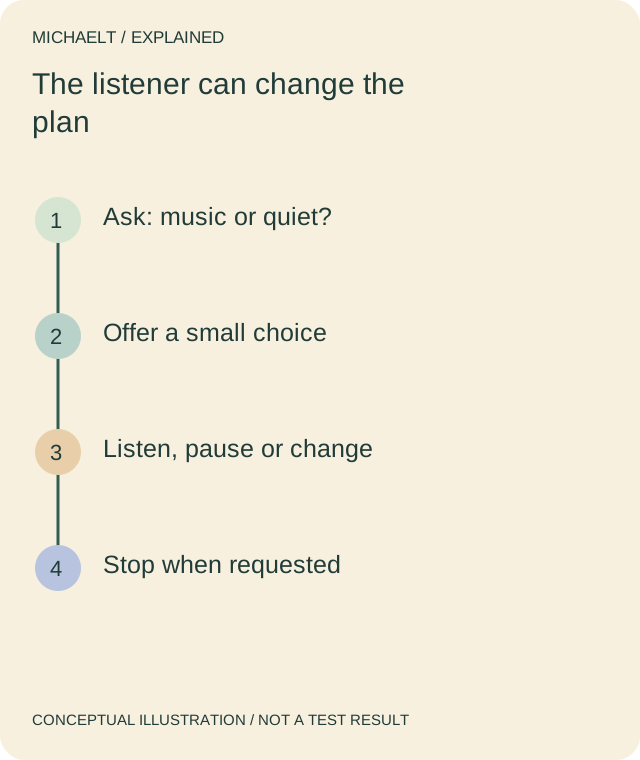
Read the drawing as text
A music visit follows the listener’s choice at every point. Stopping is a valid outcome, not a failed memory test.
Work through an example
In a fictional visit, listener L chooses track A from two offered options. After the first track they prefer a quiet conversation, so the music stops. The note records that choice for the next visit. It does not score memory, report a patient result or claim that music treated a condition.
Illustrative example; figures, people and organisations in the worked record are fictional.
The example record
Before
- Choice or preparation
- Ask whether music is wanted
- Record
- Listener-led
Source
- Choice or preparation
- Pause/stop controls available
- Record
- No forced sequence
During
- Choice or preparation
- L chooses track A
- Record
- Preference, not a test
After
- Choice or preparation
- Quiet conversation requested
- Record
- Stop and retain only useful note
Download blank worksheet (.csv) ↗Download worked example (.csv) ↗
Keep your own record
Use the result within its scope
For individual care questions use appropriate professional guidance. New activity design and the fictional example are by MichaelT editorial, not a reported consultation or a therapeutic result.
Reference sources
Earlier articles on this subject
- Different Types Of Dementias ↗ — 2022-08-18, Maria Baldwin.