Start with the care question
Use the diary to prepare for an appropriate health-care conversation. NHS guidance advises urgent or emergency help for certain headache symptoms; a diary must not delay that help. Sudden extremely painful headache, or headache with serious neurological symptoms, needs urgent assessment through the appropriate local route. Read the complete official guidance for the situation rather than relying on this short example.
Record an episode consistently
Note the date, start time, approximate duration, what you experienced and the ordinary context. NHS Inform describes keeping a migraine diary with these kinds of details. If you record medicines already taken, use the actual name, time and instructions from your existing care arrangement; do not change a dose or start a medicine to complete the record. Mark uncertain timing as estimated.
Separate an observation from a cause
A headache after a meal or screen session does not by itself prove that the activity caused it. Record the sequence without labelling every preceding event a trigger. Do not deliberately repeat a suspected exposure, withhold prescribed care or provoke symptoms to test a hypothesis. Keep any relevant questions for a qualified clinician, who can interpret the record alongside other information.
Prepare a concise handover
Bring the actual diary and a summary of questions to the appointment through the provider’s secure route. Keep identifiers and health details private. A blank day can be marked no entry rather than assumed symptom-free unless that is what you actually recorded. Ask the clinician which further details are useful instead of collecting increasingly intrusive information without a purpose.
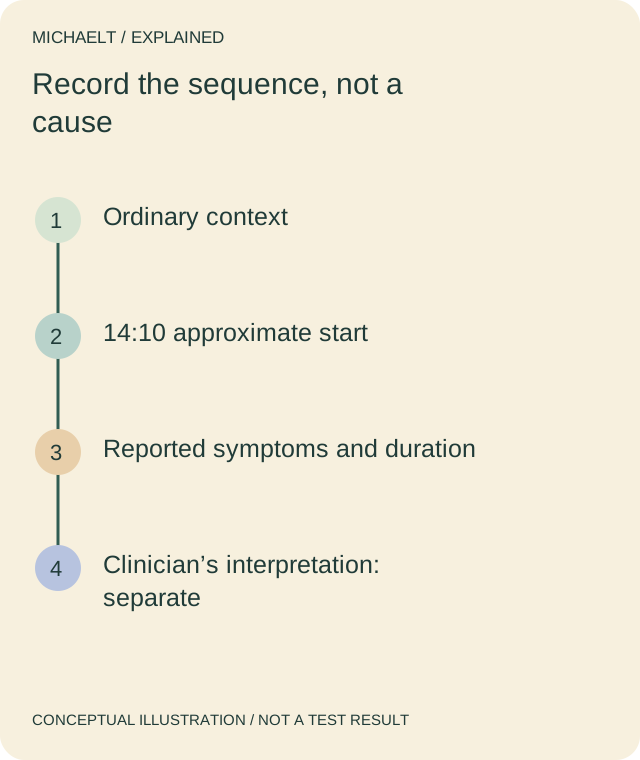
Read the drawing as text
A diary records the sequence and uncertainties. The activity before a symptom is not automatically its cause.
Work through an example
A fictional entry records a headache starting at approximately 14:10 during an ordinary workday, with the duration still to be completed. It notes the reported symptom and the person’s question for a clinician. The context field says screen work occurred earlier; the cause field is deliberately absent. No diagnosis, treatment or safe waiting period is inferred.
Illustrative example; figures, people and organisations in the worked record are fictional.
The example record
Time
- Illustrative entry
- About 14:10
- Keep distinct
- Estimate marked
Symptom
- Illustrative entry
- Person’s own description
- Keep distinct
- Not a diagnosis
Context
- Illustrative entry
- Ordinary screen work earlier
- Keep distinct
- Not a proven trigger
Question
- Illustrative entry
- Discuss with clinician
- Keep distinct
- Urgent symptoms take priority
Download blank worksheet (.csv) ↗Download worked example (.csv) ↗
Keep your own record
Use the result within its scope
This is a communication aid, not a symptom checker or a substitute for care. Use current professional advice and the appropriate urgent route when needed.
Reference sources
Earlier articles on this subject
- Migraines – Know About Prevention And Causes ↗ — 2021-09-03, Maria Baldwin.
- Treatment For Chronic Migrane Headaches ↗ — 2022-04-23, Maria Baldwin.