List loads as separate uses
For each device record its exact identity, published or measured input power and the planned operating time. Mark the source of each number. A maximum rating and a measured average are different kinds of evidence; do not quietly substitute one for the other. Split intermittent use into clearly described assumptions. A packing list alone says nothing about simultaneous demand or the required electrical arrangement.
Calculate energy with consistent units
Power in watts multiplied by hours gives watt-hours. Convert minutes to hours before multiplication and keep a separate row for each load. Divide watt-hours by 1,000 to express kilowatt-hours. These unit relationships do not account for conversion losses, starting loads, temperature, battery condition or the system’s permitted use. Do not derive battery capacity from an amp-hour label without its voltage and other relevant conditions.
Make uncertainty visible
Record whether each duration is a plan, observation or manufacturer figure. Include an unknown row rather than assigning a convenient zero to an unlisted device. If the plan changes, update the relevant duration and recalculate the total. Keep expected energy separate from the maximum simultaneous power question. A plausible daily total is not a wiring plan or evidence that a generator is safe to use.
Ask a complete system question
Take the schedule and unanswered conditions to a competent supplier or electrical professional. Ask them to assess compatibility, usable capacity, protection, charging, placement and the actual manufacturer instructions. This page does not size batteries, choose an inverter, design cabling or instruct generator operation. Keep the professional’s system proposal separate from the assumed consumption worksheet so later changes trigger a fresh assessment.
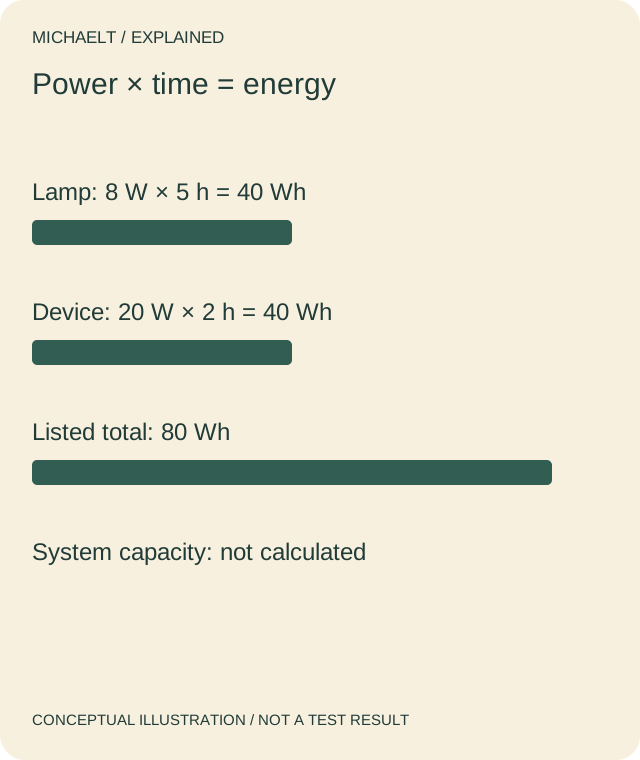
Read the drawing as text
Two assumed 40 Wh uses total 80 Wh. This is an energy schedule, not a battery-sizing or installation result.
Work through an example
Two fictional loads are planned: lamp L at 8 W for 5 hours uses 40 Wh; device D at 20 W for 2 hours uses 40 Wh. Their listed demand totals 80 Wh, or 0.08 kWh. Losses and other loads remain outside this simplified total. The figures are invented and do not establish a suitable battery or trip duration.
Illustrative example; figures, people and organisations in the worked record are fictional.
The example record
Lamp L
- Power and time
- 8 W × 5 h
- Calculated energy
- 40 Wh
Device D
- Power and time
- 20 W × 2 h
- Calculated energy
- 40 Wh
Listed total
- Power and time
- Assumed use only
- Calculated energy
- 80 Wh / 0.08 kWh
System proposal
- Power and time
- Professional assessment pending
- Calculated energy
- Losses and conditions separate
Download blank worksheet (.csv) ↗Download worked example (.csv) ↗
Keep your own record
Use the result within its scope
Retain the assumptions with the arithmetic. Correct multiplication does not verify actual consumption or make an electrical installation safe.
Reference sources
Earlier articles on this subject
- How To Set Up Your Landcruiser? ↗ — 2022-06-30, Maria Baldwin.