Name the service and entity
Record what is actually proposed: advice, arranging a product, custody or another activity. Keep the legal entity name and claimed registration reference separate from a brand name, website or individual contact. A broad phrase such as wealth management does not identify which permission would be relevant. This procedure uses the UK FCA as an example; use the correct regulator and rules for another jurisdiction.
Use an independently reached register
Navigate to the authority’s own checking service rather than a link supplied only by the seller. Compare the exact name, status and relevant permissions, including any restrictions shown. FCA guidance explains that checking authorisation requires attention to the activity offered. A firm appearing in a register does not mean every service it might mention is authorised or that an investment is suitable.
Check contact details separately
Use independently obtained official details to clarify a mismatch, following the authority’s guidance about clone firms. A copied firm reference and a similar email address can coexist. Do not send money, identity documents or banking credentials merely to complete this worksheet. Keep absence from a warning list separate from positive verification; it is not proof that a firm or offer is safe.
Keep the commercial questions open
Record the proposed fees, product, risk disclosures and the person responsible for advice. Appropriate professional and regulatory guidance may be needed to interpret scope or protections. Register verification is not a performance forecast, a guarantee against loss or a finding that the person acts as a fiduciary in every context. Preserve the date and source because status and permissions can change.
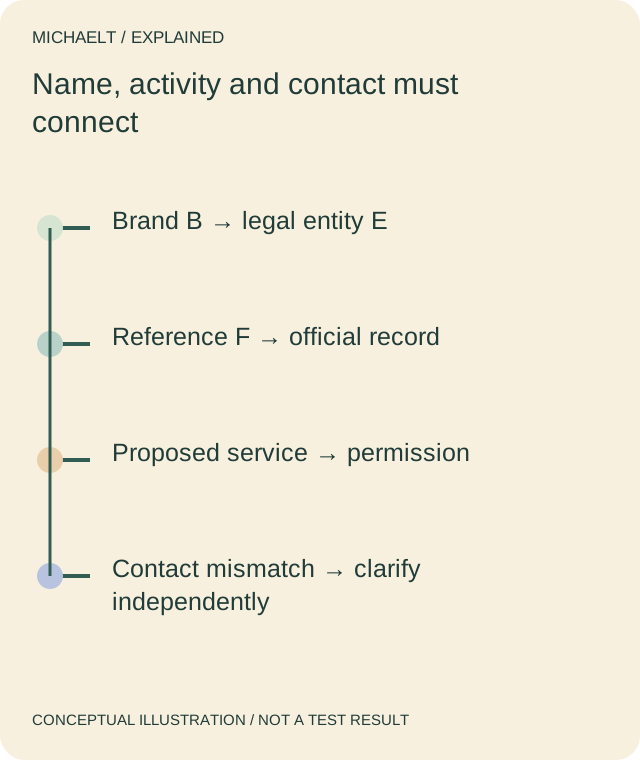
Read the drawing as text
A matching name or reference does not settle the offered activity or contact identity. Each connection needs its own check.
Work through an example
A fictional seller uses brand B and quotes reference F. The authority’s entry names entity E, but the offered contact address does not match the independently obtained one. The reader records a contact mismatch and uses the official route to clarify it. No money is transferred and no real firm is accused or endorsed.
Illustrative example; figures, people and organisations in the worked record are fictional.
The example record
Identity
- Evidence
- Entity E / reference F
- Example state
- Compare exact name
Activity
- Evidence
- Relevant permission
- Example state
- Do not infer from brand
Contact
- Evidence
- Independent official details
- Example state
- Mismatch unresolved
Decision
- Evidence
- Qualified clarification
- Example state
- No return or safety guarantee
Download blank worksheet (.csv) ↗Download worked example (.csv) ↗
Keep your own record
Use the result within its scope
Use current regulator guidance and appropriate financial advice. Verification is one due-diligence step; it does not establish suitability or promise recovery if an investment fails.
Reference sources
Earlier articles on this subject
- How to Select the Best Financial Advisor ↗ — 2021-09-17, Maria Baldwin.
- Finding a Financial Advisor in Cardiff That You Can Trust ↗ — 2021-10-18, Maria Baldwin.
- Things to Consider Before Choosing an Asset Management Company ↗ — 2020-12-30, Maria Baldwin.
- What Services Do Family Offices Provide? ↗ — 2021-07-07, Maria Baldwin.