Identify the surface first
Record the board or scooter model and the exact grip material if the maker identifies it. A photograph of a scooter deck does not identify every skateboard surface or replacement tape. Keep the product’s instructions with its model reference. Do not disassemble equipment, apply a solvent or wet a surface merely because an old cleaning article uses the word grip.
Read the actual cleaning-product description
MOB’s manufacturer-owned NHS Skate Direct store lists a gum product intended to remove dirt and dust from grip tape. That is a narrower starting point than a universal household-cleaner recipe. Record the actual product and scope, then obtain and follow its instructions for the intended surface. Do not treat promotional wording such as like new as a measured test or a guarantee about an old board.
Keep care and condition separate
Record a visible dirty area separately from lifting tape, damaged edges or any concern about the equipment’s condition. A cleaning result cannot establish that the board is structurally sound or safe to ride. If material identity, compatibility or condition is uncertain, ask the relevant manufacturer or competent service. This page does not provide a pressure, scraping, drying or riding-test procedure.
Retain a modest outcome record
Note the source of the care instructions, the product used within them and the directly observed outcome. Keep unchanged concerns open rather than closing them because the surface looks cleaner. Avoid before-and-after performance claims without an appropriate actual test. The worksheet is useful for asking the right product question; it does not recommend every rider buy a particular cleaner.
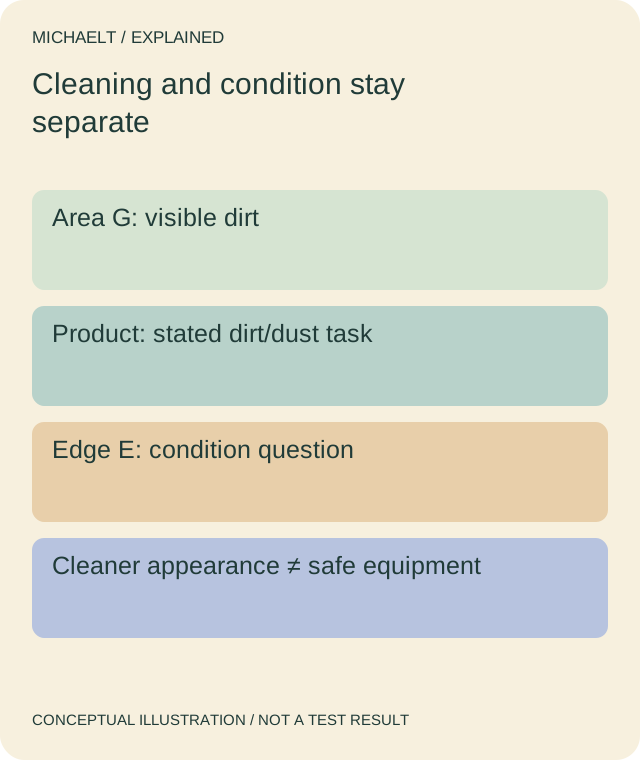
Read the drawing as text
A cleaning task cannot resolve a lifted edge or establish riding safety. Keep the two observations in separate rows.
Work through an example
A fictional owner records dirt on area G and a separate lifted edge E. The cleaning product’s description concerns dirt and dust, so E remains a condition question for the equipment maker. A cleaner-looking area G would not close E or prove restored traction. No real product or riding test is represented.
Illustrative example; figures, people and organisations in the worked record are fictional.
The example record
Surface
- Example
- Grip material to identify
- Limit
- Do not infer from image
Product
- Example
- Maker’s dirt/dust description
- Limit
- Not a universal solvent
Condition
- Example
- Lifted edge E
- Limit
- Separate enquiry
Outcome
- Example
- Visible appearance only
- Limit
- No riding-performance claim
Download blank worksheet (.csv) ↗Download worked example (.csv) ↗
Keep your own record
Use the result within its scope
Use the exact maker’s instructions and obtain help for equipment concerns. No universal wet-cleaning recipe or safety certification is supplied.
Reference sources
Earlier articles on this subject
- How to Clean the Grip Tape on Your Skateboard ↗ — 2021-02-03, Maria Baldwin.