Use a label, not a mineral story
Find the Nutrition Facts panel and ingredient information for the actual food product. The FDA distinguishes sodium from table salt and advises checking serving size when comparing products. Record sodium in milligrams and the corresponding serving mass in grams. Do not treat a decorative salt lamp, a bath product or an unlabelled mineral sample as a food. A broad natural claim supplies neither a sodium value nor proof of a health effect.
Normalise one declared quantity
For a document comparison, divide the labelled sodium per serving by the serving mass. This gives milligrams of sodium per gram of product. Keep the original numbers so somebody else can repeat the arithmetic. Use mass rather than assuming that two spoonfuls of differently sized crystals contain the same amount. The calculation compares declared values; it does not measure an actual product, portion or laboratory composition.
Read the remaining claims independently
Check whether the ingredient list actually declares iodine or other ingredients rather than inferring them from salt colour or origin. A statement about sodium does not establish taste, iodine suitability or a clinical benefit. Follow individual dietary advice from the relevant qualified professional. This worksheet does not prescribe a daily allowance, recommend increasing salt intake or turn marketing about minerals into treatment for blood pressure or another condition.
Keep a comparable conclusion
Write the result in the units you calculated and state the limits. If the serving mass is missing, ask the manufacturer rather than inventing a conversion. If labels use different bases, retain that question until resolved. Do not call a product healthier because its stated portion is smaller, and do not confuse a no-added-salt statement with a measured absence of sodium.
Read the drawing as text
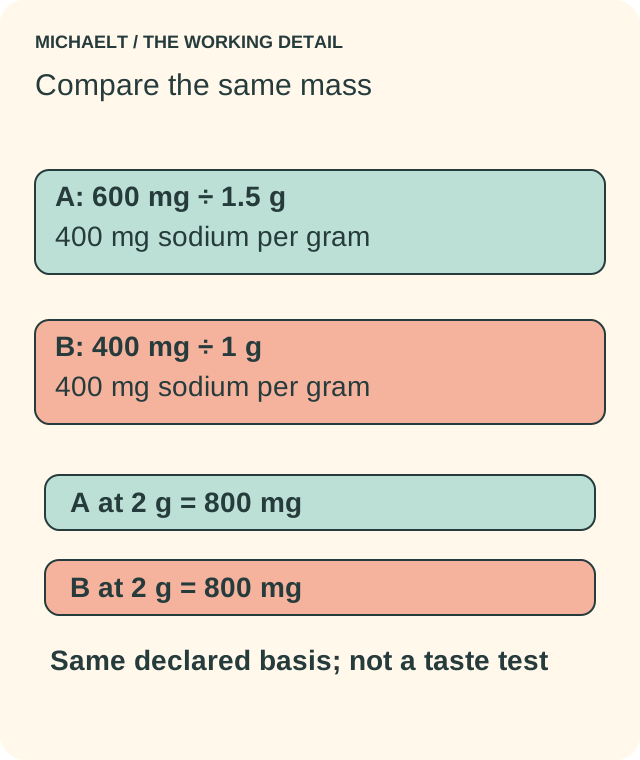
Fictional salt A: 600 mg sodium divided by 1.5 g equals 400 mg/g. B: 400 mg divided by 1 g also equals 400 mg/g. At 2 g, both scale to 800 mg; this is not a product test.
Work through an example
Two fictional labels give A: 600 mg sodium per 1.5 g serving, and B: 400 mg per 1 g serving. A gives 600 ÷ 1.5 = 400 mg/g; B gives 400 ÷ 1 = 400 mg/g. At a comparison mass of 2 g, both declared values scale to 800 mg. This arithmetic does not say that two real salts taste the same or suit the same person.
Illustrative example; figures, people and organisations in the worked record are fictional.
The example record
A
- Declared amount or detail
- 600 mg / 1.5 g
- Comparison result
- 400 mg/g
B
- Declared amount or detail
- 400 mg / 1 g
- Comparison result
- 400 mg/g
Equal comparison mass
- Declared amount or detail
- 2 g of either example
- Comparison result
- 800 mg declared sodium
Unresolved claim
- Declared amount or detail
- Iodine or mineral benefit
- Comparison result
- Not inferred from colour
Download blank worksheet (.csv) ↗Download worked example (.csv) ↗
Keep your own record
Use the result within its scope
Use the actual label and the advice relevant to your circumstances. The FDA source concerns US nutrition labelling; do not transplant its terminology into a different jurisdiction without checking local rules. No product, diet or medical outcome is endorsed.
Reference sources
Earlier articles on this subject
- How to Buy Himalayan Salt? ↗ — 2020-12-16, Maria Baldwin.
- Does Regular Table Salt Reduce the Risk of Heart Disease? ↗ — 2021-07-28, Maria Baldwin.
- Himalayan Salt And Its Popularity ↗ — 2021-02-15, Maria Baldwin.
- The Different Types of Himalayan Salt ↗ — 2021-01-19, Maria Baldwin.
- What is Himalayan Pink Salt? ↗ — 2021-01-01, Maria Baldwin.
- The Himalayan Pink Salt ↗ — 2020-12-27, Maria Baldwin.