

Agree who receives what
Confirm the actual carrier, contracting party, handover contacts and the documents they require. Keep private identifiers and addresses off public copies. Record which vehicle and agreed supplied items the handover concerns, using the actual private reference. Ask about the collection and delivery arrangements and the carrier’s process for noting a discrepancy. Insurance coverage and liability come from the real terms and appropriate advice, not a transport photograph.
Make a usable condition reference
Where it is appropriate and safe, record dated photographs of the agreed areas before handover and link them to neutral identifiers. Retain originals. Use consistent labels such as front-left view or item K rather than hundreds of unlabelled images. State what is visible and what was not observed. A photograph of a mark does not establish its cause, repair cost or the legal responsibility for it.
Reconcile the handover receipt
Match the vehicle, agreed items, observed exceptions and actual recipient against the carrier’s record. Ask how any disagreement is documented before treating a signature as a complete account of condition. Follow the carrier’s actual safety and access instructions; this article supplies no loading, restraint, driving or inspection procedure. Do not enter a loading area or reach under a vehicle to complete a photograph checklist.
Compare at delivery without inventing certainty
Use the same condition references when the vehicle is delivered, to the extent the actual process permits. Record observations, the date, who received the vehicle and any discrepancy raised through the carrier’s stated process. Keep the original evidence intact and seek appropriate advice on a dispute. A matching item count proves neither mechanical condition nor absence of damage outside the observed views.
Read the drawing as text
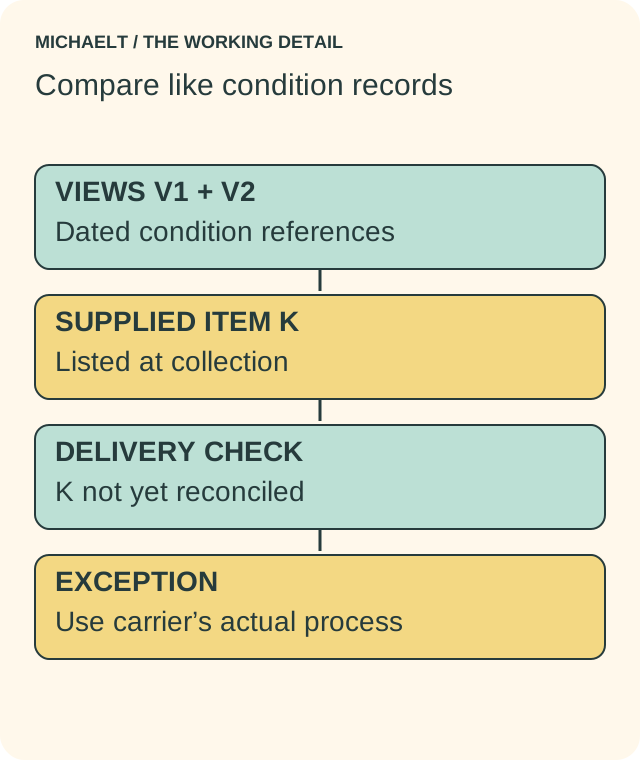
Keep dated views V1 and V2 separate from supplied item K. Collection and delivery observations are reconciled; a missing K becomes an exception, not an assumed receipt.
Work through an example
A fictional record contains views V1 and V2 and supplied item K. At collection, V2 records an existing visible mark. At delivery, K is not reconciled, so an exception is raised rather than silently ticking all received. The example identifies no real vehicle, carrier, insurance policy or damage claim.
Illustrative example; figures, people and organisations in the worked record are fictional.
The example record
V1
- Collection record
- Dated original view
- Delivery question
- Comparable view available?
V2
- Collection record
- Existing mark recorded
- Delivery question
- What is actually observed now?
Item K
- Collection record
- Listed on handover
- Delivery question
- Receipt not yet reconciled
Exception
- Collection record
- Named carrier process
- Delivery question
- Acknowledgement retained
Download blank worksheet (.csv) ↗Download worked example (.csv) ↗
Keep your own record
Use the result within its scope
Keep the condition record separate from a diagnosis, valuation or legal claim. Carrier terms, insurance and any reporting deadlines need to be checked for the actual arrangement.
Earlier articles on this subject
- Hire Covered Car Transportation For Your Vehicle Safety ↗ — 2021-11-24, Maria Baldwin.
- How To Choose The Right Car Detailing Company? ↗ — 2022-02-11, Maria Baldwin.
- Automotive Paint Color Repair Can Be Simple ↗ — 2021-07-16, Maria Baldwin.
- Advantages Of Sydneys Replacement Car Rental Services ↗ — 2022-08-04, Maria Baldwin.