Start with the fungal meaning
Kew describes truffles among the reproductive structures of fungi, with mycelium forming a less visible part of the organism. That is a different biological context from crustaceans or mineral salts. The earlier source’s claims that truffles are seafood, volcanic products or chocolate transformed into fungi are not retained. This explanation is about words and food descriptions, not identifying edible organisms in the wild.
Read the seasoning as a blend
A product called truffle salt is a named seasoning whose actual ingredients must be read from its own label. Do not assume a particular species, percentage of truffle, flavouring or allergen profile from the front name. A photograph can show packaging but cannot establish the current formulation. Keep the exact product and label version if you need to ask the maker about an ingredient.
Keep the confection in another column
Chocolate truffle is also a confectionery name. It does not imply that a fungal truffle is an ingredient. Read the actual recipe or product information rather than carrying ingredients between the two meanings. Do not use this distinction to declare a food allergen-free or suitable for a particular person. For an actual dietary concern, seek exact verified information and appropriate advice.
Turn an unclear menu into a precise question
Ask what the named item actually contains and which ingredient or flavour the description refers to. Retain the answer for that item and date. A general article cannot authenticate an expensive ingredient, establish a supplier’s species claim or make an unknown mushroom safe to eat. This exercise does not teach foraging, food preservation or a substitute recipe.
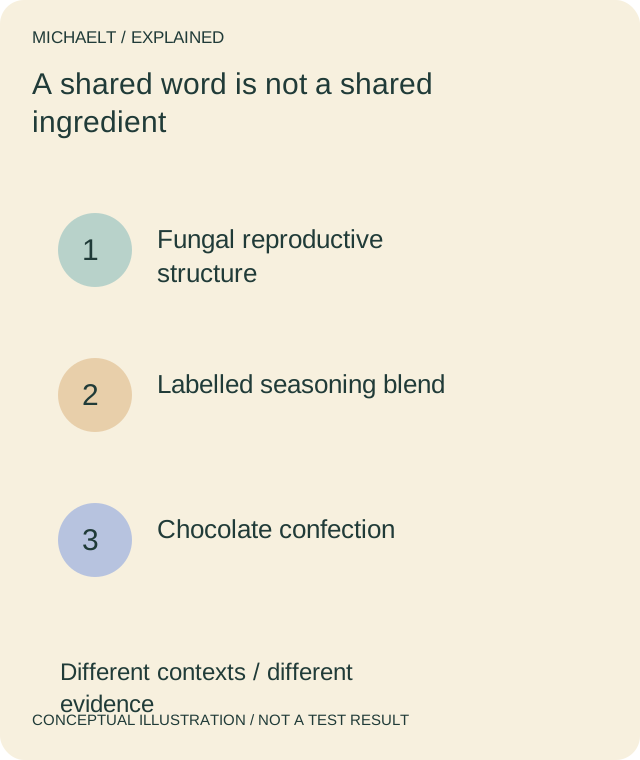
Read the drawing as text
The biological truffle, a seasoning blend and a chocolate confection belong to different contexts. Their ingredient lists cannot be inferred from the shared name.
Work through an example
A fictional menu lists truffle salt on dish A and chocolate truffles for dessert B. The reader asks for A’s seasoning ingredients and B’s confectionery ingredients separately. Neither name supplies a percentage, species identification or allergen conclusion. No real product is tasted, authenticated, identified from the wild or recommended for a dietary need.
Illustrative example; figures, people and organisations in the worked record are fictional.
The example record
Fungal truffle
- Illustrative evidence
- Reproductive structure of a fungus
- Meaning or next step
- Biological context
Truffle salt
- Illustrative evidence
- Actual labelled blend
- Meaning or next step
- Read its own ingredients
Chocolate truffle
- Illustrative evidence
- Confectionery name
- Meaning or next step
- Does not imply fungal content
Menu enquiry
- Illustrative evidence
- A and B checked separately
- Meaning or next step
- No inferred allergen conclusion
Download blank worksheet (.csv) ↗Download worked example (.csv) ↗
Keep your own record
Use the result within its scope
A precise ingredient question is more useful than a dramatic origin story. Keep actual labels and supplier answers, and never use a common food name or this drawing to identify wild fungi for consumption.
Reference sources
Earlier articles on this subject
- Why Is Black Truffles Salt Rich in Sulfur? ↗ — 2021-07-13, Maria Baldwin.
- Black Truffle Sea Salt and Pasta ↗ — 2022-02-01, Maria Baldwin.