Choose the reading task
State whether you want to understand a passage, compare translations, investigate a historical claim or prepare a question for a class. Choose a manageable passage rather than claiming to master a tradition from a short summary. Treat religious, literary and philosophical works with attention to their context and the perspectives of readers; a course advertisement cannot determine the correct interpretation for everyone.
Identify the edition
Record the title, named author or attributed tradition, editor or translator, publisher, edition date and stable passage reference. A page number alone may not survive a change of edition or digital format. Keep the original text’s historical context separate from the date of a modern publication. If attribution or dating is uncertain, retain that uncertainty rather than inventing an author.
Separate text and interpretation
Use separate fields for a short passage reference, your observation, the translator’s note and a commentator’s interpretation. The Library of Congress encourages examining source context, purpose and perspective. A later commentary can be useful without becoming the original source. When two translations differ, identify the editions and the specific difference rather than treating one word in isolation as proof of a sweeping claim.
Turn uncertainty into a question
Write one question that the passage and context actually raise. Identify what additional primary material or qualified teaching could help answer it. Keep paraphrases labelled as your own and quotation use proportionate with proper attribution. A personal reading note is not a credential, a theological judgement or permission to reproduce an entire copyrighted translation.
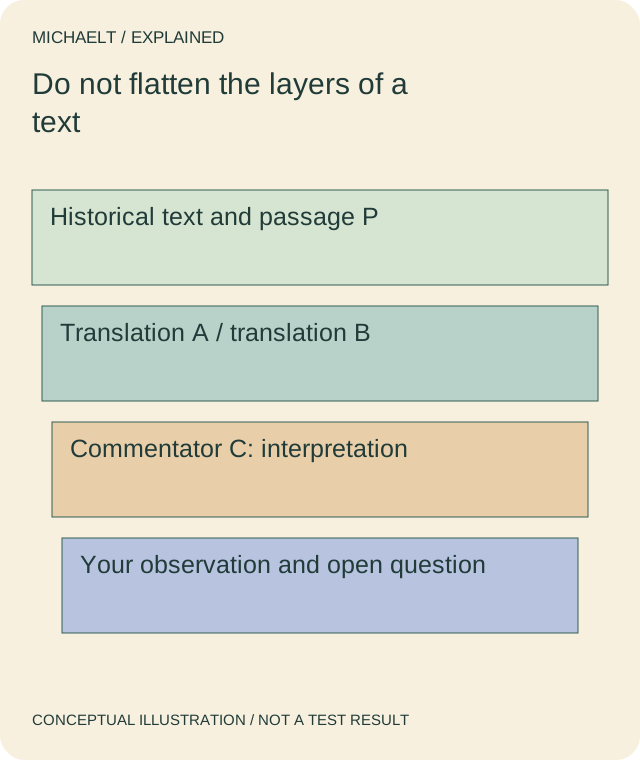
Read the drawing as text
Text, translation, commentary and a reader’s own question are separate layers with separate attribution.
Work through an example
A fictional reader compares passage P in translations A and B. A uses term X while B uses Y; commentator C offers one interpretation. The note preserves the edition details, marks the difference and asks a teacher how the surrounding passage affects the reading. It does not merge C’s interpretation into the source text or claim that the exercise settles a tradition’s meaning.
Illustrative example; figures, people and organisations in the worked record are fictional.
The example record
Source
- Evidence
- Passage P / edition A
- Next question
- Stable reference?
Translation
- Evidence
- Edition B uses Y
- Next question
- Which translator and date?
Commentary
- Evidence
- C offers an interpretation
- Next question
- Keep distinct from source
Own note
- Evidence
- Question about context
- Next question
- What would help answer it?
Download blank worksheet (.csv) ↗Download worked example (.csv) ↗
Keep your own record
Use the result within its scope
A traceable reading record supports discussion and further study. It does not establish a uniquely correct interpretation, confer a qualification or erase the original author, translator or publication date.
Reference sources
Earlier articles on this subject
- Choose Best Courses To Study In Vedic Studies ↗ — 2021-04-29, Maria Baldwin.
- What Are the Benefits to Learn Quran Online ↗ — 2021-03-25, Maria Baldwin.
- Indian Vedic Science-Addresses All Aspects Of Hinduism ↗ — 2021-05-26, Maria Baldwin.