Keep the screening question precise
NCI describes screening as looking for disease before symptoms and explains possible false-positive and false-negative results. A screening result can lead to further assessment; it does not itself settle every diagnostic question. This page does not recommend a cancer screen, a full-body scan or a particular test. Actual screening choices and symptoms require the appropriate qualified professional and current local guidance.
Define the invented population
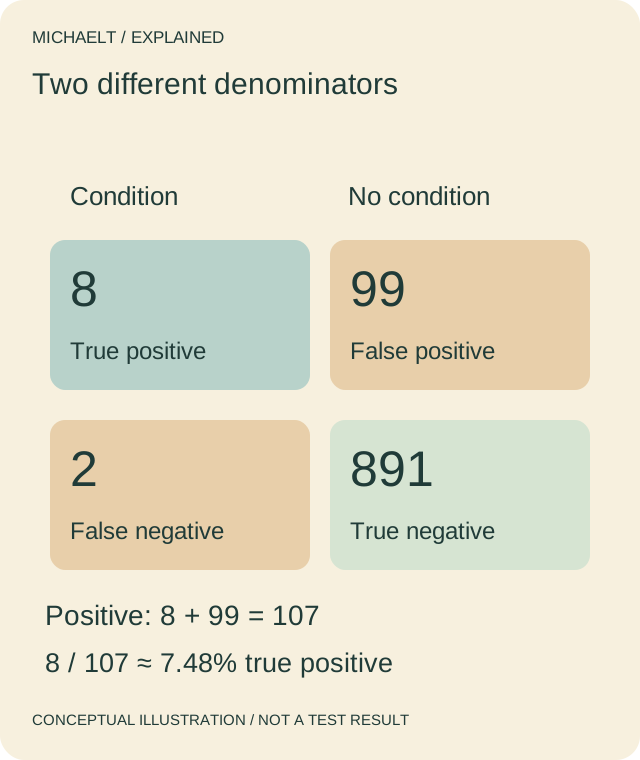
For a reading exercise only, suppose the true condition is present in 10 of 1,000 fictional people. Invent a test that is positive in eight of those ten and negative in two. Among the remaining 990 people, suppose 99 have a positive result and 891 a negative result. These are deliberately invented counts, not the accuracy or prevalence of any real disease or test.
Change the denominator deliberately
Among the ten people with the condition, eight are detected: 8 / 10 = 80%. Among everyone with a positive result, however, there are 8 true positives plus 99 false positives, making 107 positives. The true-positive share of that positive group is 8 / 107, approximately 7.48%. The two percentages answer different questions; neither can replace the other.
Keep uncertainty and next steps visible
There are also two false negatives in the example. A negative result is therefore not presented as a universal all-clear, and a positive result is not a diagnosis. Real interpretation depends on the test, population, evidence and clinical context. Ask the responsible clinician what the result means and which next step applies. Do not use these invented figures to assess yourself or delay attention to symptoms.
Read the drawing as text
In the fictional group, 8 of 10 cases are detected, but only 8 of 107 positive results are true positives. The four cells total 1,000. These are not real test data.
Work through an example
The four fictional cells reconcile: 8 true positives + 2 false negatives + 99 false positives + 891 true negatives = 1,000. Positive results total 107 and negative results total 893. Saying the invented test detects 80% of cases does not mean that 80% of people with a positive result have the condition. No real test performance is asserted.
Illustrative example; figures, people and organisations in the worked record are fictional.
The example record
Condition / positive
- Illustrative evidence
- 8
- Meaning or next step
- True positives
Condition / negative
- Illustrative evidence
- 2
- Meaning or next step
- False negatives
No condition / positive
- Illustrative evidence
- 99
- Meaning or next step
- False positives
No condition / negative
- Illustrative evidence
- 891
- Meaning or next step
- True negatives
Download blank worksheet (.csv) ↗Download worked example (.csv) ↗
Keep your own record
Use the result within its scope
Use the diagram to practise reading denominators, not to choose or interpret a real screening test. Real results and any concerning symptoms belong with an appropriately qualified clinical service.
Reference sources
Earlier articles on this subject
- What You Need To Know About Oral Cancer Screening ? ↗ — 2021-11-24, Maria Baldwin.
- Different Types Of Full Body Scans In Raleigh ↗ — 2022-08-25, Maria Baldwin.