Use the real instrument and guidance
FDA’s refrigerator-thermometer information explains why an appliance thermometer matters for food storage. Use the actual instrument’s instructions and applicable food-safety guidance; a control dial setting is not automatically a measured temperature. Keep the instrument, unit, placement information as specified and source of any target together. This page does not calibrate a device or replace current instructions for handling food.
Record what was actually read
Write the date, approximate time if necessary, displayed value and unit. Mark whether it is a current reading or a device’s defined minimum or maximum; use the actual manual to understand those functions and their interval. Keep instrument changes or missing records explicit. Do not convert a blank cell into zero, a normal reading or proof that a refrigerator was continuously operating correctly.
Draw the unobserved interval honestly
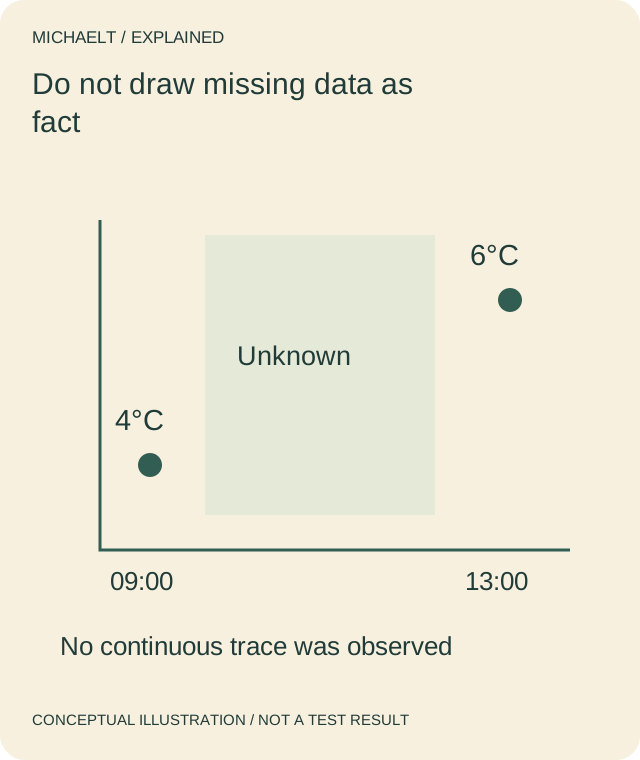
Two snapshots four hours apart do not reveal the temperature at every minute between them. A maximum without a known reset period also needs context. Do not calculate a food-safety exposure duration by joining two points and treating the line as observed data. A schematic can show the gap, but it should label that gap unknown rather than imply a logged continuous trace.
Use the appropriate response route
For a real concern, follow current food-safety guidance and the appropriate qualified service rather than waiting for a prettier record. Keep equipment assessment separate from advice about affected food. Do not dismantle the refrigerator, adjust hinges, clean internal coils or invent disposal decisions from this example. Supply the actual readings and context through the relevant verified contact.
Read the drawing as text
The two fictional readings are four hours apart. The time between them is unobserved, so no continuous trace or exposure duration is established.
Work through an example
A fictional notebook records 4°C at 09:00 and 6°C at 13:00. Four hours separate the observations, but the intervening history is unknown. The record does not claim four hours above any threshold or decide whether food is safe. Those values illustrate time-stamped snapshots only; the responsible person follows current guidance for the actual circumstances.
Illustrative example; figures, people and organisations in the worked record are fictional.
The example record
Instrument
- Illustrative evidence
- Actual model and unit
- Meaning or next step
- Dial is not necessarily measurement
09:00
- Illustrative evidence
- Fictional 4°C snapshot
- Meaning or next step
- Only that observation
13:00
- Illustrative evidence
- Fictional 6°C snapshot
- Meaning or next step
- Intervening history unknown
Next action
- Illustrative evidence
- Appropriate food/equipment advice
- Meaning or next step
- No exposure duration inferred
Download blank worksheet (.csv) ↗Download worked example (.csv) ↗
Keep your own record
Use the result within its scope
A clear log preserves uncertainty and helps the right professional understand the question. It does not establish continuous storage conditions, diagnose equipment, approve food or supply a universal fault or disposal rule.
Reference sources
Earlier articles on this subject
- How To Repair and Care For Your Refrigerator ↗ — 2021-04-10, Maria Baldwin.
- The Refrigeration Service You Need ↗ — 2021-01-15, Maria Baldwin.