Choose the correct authority
Start with the relevant product-safety authority for the product and country. The US CPSC recall and warning directory is linked here as one official starting point, not as a worldwide database of every product. Vehicles and some other categories have different authorities. Do not rely on an old best-products article or a social post to decide that a current item is unaffected.
Read the exact notice
Record the notice URL, date, named product, model identifiers and any manufacturing, serial or date-code conditions it uses. Check how the notice says to identify the product. Do not dismantle an item or perform an unsafe demonstration to find a code. If an identifier is missing or illegible, contact the notice’s official enquiry route rather than matching on colour or a broad family name alone.
Compare every condition
Use one row for each identifying condition and record matches, mismatches and unknowns separately. A matching brand with an unknown model remains unresolved. Preserve a dated copy or reference, because the CPSC directory explains that remedy information can change. No match found in a particular search is not a safety certification, and a recall match is not permission to improvise a repair.
Follow the actual remedy route
If the notice applies, follow its current instructions and contact route. Do not use a generic refund, disposal, return-shipping or continued-use instruction from this worksheet. Those actions can differ by product and notice. Keep the response and completion evidence privately. If applicability is unclear, seek clarification from the authority or named manufacturer through verified details rather than treating an online comment as a decision.
Read the drawing as text
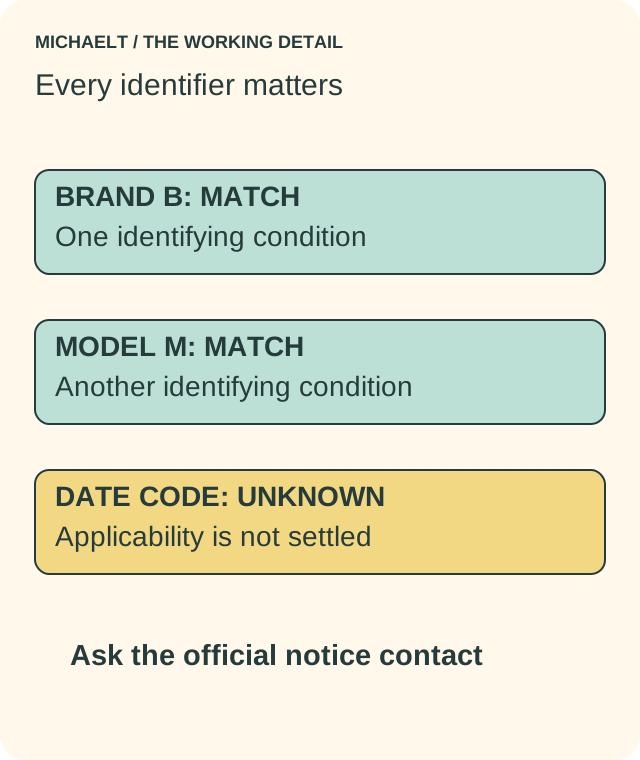
Illustrative recall comparison: brand B matches, model M matches, date code unknown. The unknown condition remains unresolved; do not declare the product safe or recalled from appearance.
Work through an example
A fictional notice identifies model M and date-code range D. An owner’s label confirms brand B and model M, but the date code is unreadable. The record marks the model matched and the date condition unknown, then directs the question to the official notice contact. No real stroller, appliance or battery is declared recalled or safe.
Illustrative example; figures, people and organisations in the worked record are fictional.
The example record
Brand
- Illustrative observation
- B
- State
- Matches notice
Model
- Illustrative observation
- M
- State
- Matches notice
Date-code condition
- Illustrative observation
- Unreadable
- State
- Unknown: clarify
Remedy
- Illustrative observation
- Read current notice
- State
- No generic repair or disposal
Download blank worksheet (.csv) ↗Download worked example (.csv) ↗
Keep your own record
Use the result within its scope
Keep the scope exact. This procedure does not test the product, establish overall safety or decide compensation. Follow the actual authority and notice for your item, including any immediate instructions they give.
Reference sources
Earlier articles on this subject
- A Review of the Best Single Baby Strollers ↗ — 2021-05-25, Maria Baldwin.
Continue with a related task
Understand the limits of a vehicle VIN recall lookup
Add the search type and its exclusions before interpreting a zero result as a complete vehicle history.
Choose the vehicle-specific search
NHTSA distinguishes a VIN or plate search for unrepaired recalls on a specific vehicle from broader year, make and model results. Use the correct official tool and actual identifier privately. Do not submit a made-up VIN to a real lookup for this exercise. Save the search date and type with the result rather than quoting a number without context.
Retain the exclusions
The NHTSA page states that the VIN lookup does not show already repaired recalls and may omit some newly announced campaigns while VINs are being identified. It lists further scope limits, including some older and international recalls. Read the current exclusions for the tool. A zero unrepaired-recall result is not a complete repair history, safety inspection, warranty record or legal determination.
Ask a precise follow-up question
If documents or a manufacturer notice raise an unresolved campaign question, use the official manufacturer or authority route for that vehicle. Keep the actual response and any remedy record separate from the lookup. Follow applicable recall instructions; this page supplies no repair procedure and cannot decide eligibility for compensation, a class action or a particular legal remedy.
Read the drawing as text
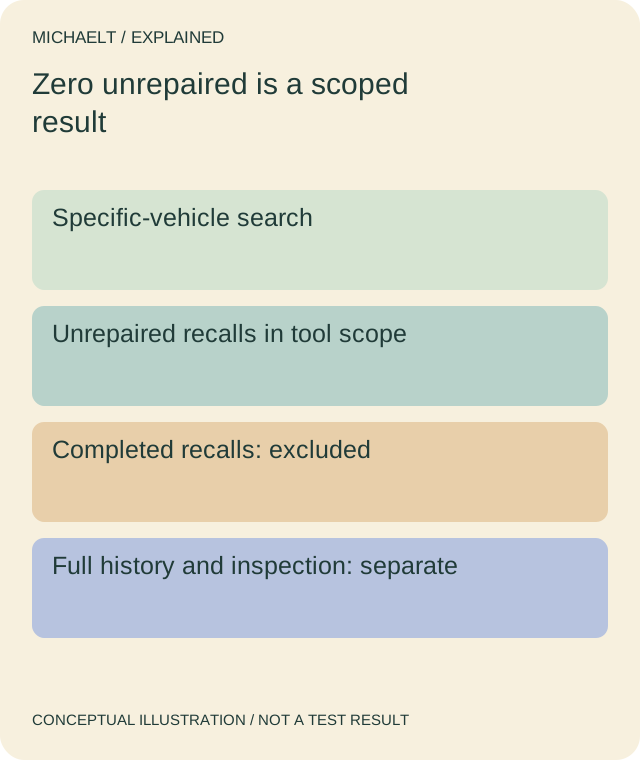
NHTSA’s vehicle-specific result concerns unrepaired recalls within its scope. Completed campaigns and a complete vehicle history are different evidence.
Work through an example
A fictional record stores a dated zero-unrepaired result from a vehicle-specific lookup. A separate service document refers to an earlier completed campaign. These do not automatically conflict because the tool excludes repaired recalls. The owner asks the appropriate official contact about the service document rather than calling the lookup a complete history. No actual vehicle or VIN is checked in this illustration.
Illustrative example; figures, people and organisations in the worked record are fictional.
The example record
Search
- Evidence
- Vehicle-specific lookup
- Next question
- Date and identifier private
Result
- Evidence
- Zero unrepaired in example
- Next question
- Not complete history
Other record
- Evidence
- Earlier completed campaign
- Next question
- Different scope
Follow-up
- Evidence
- Official vehicle contact
- Next question
- Actual remedy evidence separate
Download blank worksheet (.csv) ↗Download worked example (.csv) ↗
Keep your own record
Use the result within its scope
Use the exact authority, vehicle and current tool limitations. The record helps interpret a result; it does not clear a vehicle for use, establish all recalls worldwide or determine a lawsuit or payment entitlement.
Reference sources
Earlier articles on this subject
- What Is The GM Class Action Lawsuit About? ↗ — 2022-07-19, Maria Baldwin.