Choose a useful private record
Write what you actually experienced in your own words, when it happened and what ordinary activity it affected. NHS endometriosis information explains why symptoms and everyday impact matter in an assessment; the same page notes overlap with other conditions. A symptom label or recurring pattern in a notebook is not a diagnosis. Ask the clinical team what information would be useful for your appointment.
Keep time and observation distinct
Use dates and, when useful, approximate times. Mark an estimated time as approximate. Leave a period with no record labelled not recorded rather than assigning zero symptoms. If you use your own severity scale, define it and use it consistently; do not present it as a validated clinical test. Share only relevant sensitive details privately with the treating professional, not through a public spreadsheet.
Record actual care rather than planning treatment
Keep questions about existing professional instructions and any concerns about them. Do not create a medication, hormone, diet or exercise plan from an old article. The Norfolk and Norwich NHS service describes symptom history as useful but not sufficient for a firm diagnosis. A diary should support the appointment, not become a reason to postpone seeking appropriate help.
Prepare one clear question
Summarise the pattern you noticed, its practical effect and what you want the clinician to clarify. Bring the original record so a brief summary does not hide missing days. If symptoms are urgent, worsening or otherwise concerning, use the appropriate local clinical route rather than waiting to finish a diary. This site does not collect symptom records or assess individual health.
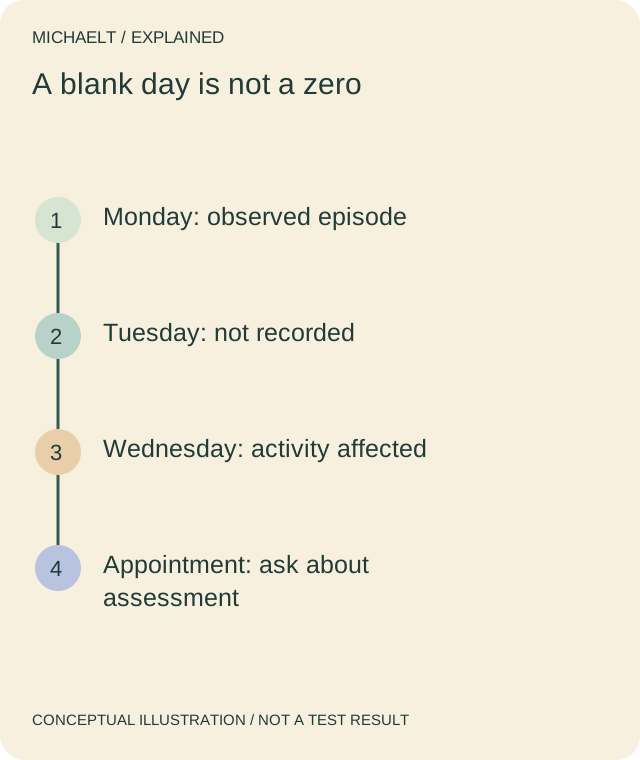
Read the drawing as text
Two observed episodes and one missing day are different evidence. A blank entry cannot be converted into a symptom-free day.
Work through an example
A fictional note records discomfort on Monday and Wednesday and a missed usual activity on Wednesday. Tuesday has no entry. The appointment summary says two recorded episodes and one unrecorded day; it does not call Tuesday symptom-free or infer a cause. The person asks a clinician what assessment is appropriate. No patient, symptom score or clinical outcome is represented.
Illustrative example; figures, people and organisations in the worked record are fictional.
The example record
Monday
- Illustrative evidence
- Episode recorded
- Meaning or next step
- Own words and approximate time
Tuesday
- Illustrative evidence
- No entry
- Meaning or next step
- Not recorded, not zero
Wednesday
- Illustrative evidence
- Episode and activity affected
- Meaning or next step
- Keep practical impact
Appointment
- Illustrative evidence
- Question about assessment
- Meaning or next step
- No diagnosis from the pattern
Download blank worksheet (.csv) ↗Download worked example (.csv) ↗
Keep your own record
Use the result within its scope
The record is a communication aid. It cannot establish a diagnosis, rule out another condition or determine whether an existing treatment should change. Use qualified advice and the appropriate urgency for the actual circumstances.
Reference sources
- NHS: endometriosis and preparing for assessment ↗
- Norfolk and Norwich University Hospitals: endometriosis appointment and symptom history ↗
Earlier articles on this subject
- How to Cope with endometriosis successfully? ↗ — 2021-07-19, Maria Baldwin.