Copy the label basis
Retain the actual product, label date, serving size and units beside the nutrient amount. A number without its denominator is not ready for comparison. Distinguish one serving from the entire package and a mass-based comparison from a typical portion. Keep a missing serving size unanswered rather than borrowing one from a different food or supplement.
Read the percentage correctly
The FDA supplement-labelling guide describes percentage Daily Value in relation to the amount per serving and the relevant Daily Value. It is not the percentage absorbed by a person, the proportion of a meal or a promised clinical benefit. Not every ingredient has an established Daily Value. Check the actual label and applicable population rather than inventing a percentage for an unlisted reference.
Show limited arithmetic
For a simple comparison, state the number of labelled servings and multiply the stated amount by that number. Keep the units unchanged and show each assumption. Do not turn this arithmetic into a recommended intake or a reason to double a supplement. Actual needs, suitability, medication interactions and advice about nutrition belong to the appropriate qualified professional.
Separate marketing from the table
Write a performance or health claim in a separate column and ask what evidence supports that exact claim. A higher number on the label does not by itself establish faster recovery, better absorption or suitability before exercise. Use the product’s actual instructions and professional advice rather than creating a workout diet from a general article. Keep uncertainty visible when comparing different label formats.
Read the drawing as text
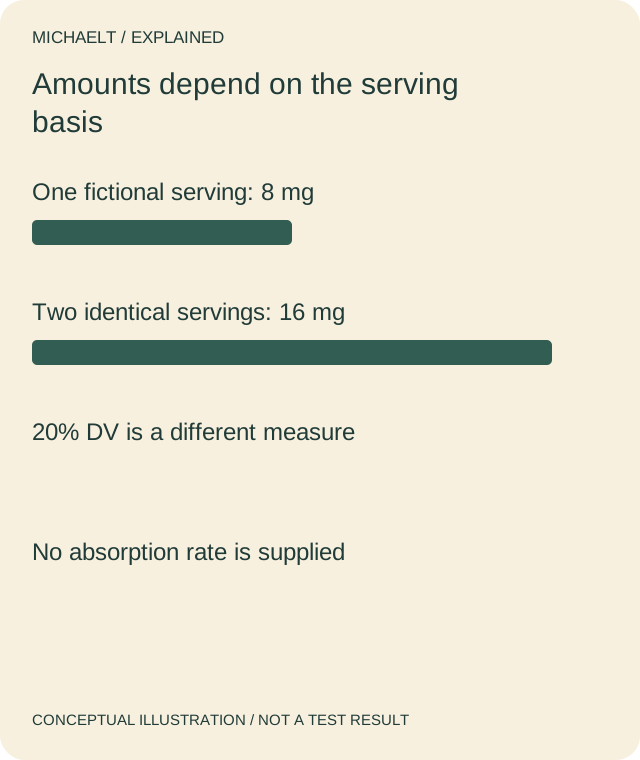
One fictional serving contains 8 mg; two contain 16 mg. Percentage Daily Value is not an absorption percentage or a clinical outcome.
Work through an example
A fictional label states 8 mg of nutrient X per serving and 20% DV. Two such servings contain 16 mg by multiplication, assuming identical servings. The 20% does not mean that 20% is absorbed, and the calculation does not recommend two servings. Another product’s 8 mg per package cannot be compared until the package and serving basis are known.
Illustrative example; figures, people and organisations in the worked record are fictional.
The example record
Serving basis
- Evidence
- One stated serving
- Next question
- Same basis across products?
Amount
- Evidence
- 8 mg per serving
- Next question
- Two servings: 16 mg
Percentage
- Evidence
- 20% DV on fictional label
- Next question
- Not absorption or benefit
Claim
- Evidence
- Improves recovery
- Next question
- Separate evidence needed
Download blank worksheet (.csv) ↗Download worked example (.csv) ↗
Keep your own record
Use the result within its scope
Use exact labels and an appropriate comparable basis. This is a reading exercise, not an intake target, medical recommendation or endorsement of supplements. A correct multiplication cannot establish personal nutritional suitability.
Reference sources
Earlier articles on this subject
- For Maximum Results – What Should You Eat Before And After A Workout? ↗ — 2021-04-19, Maria Baldwin.
- Is Prickly Pear Cactus Powder Really A Superfood? ↗ — 2022-06-09, Maria Baldwin.