Describe the help you are seeking
Write a short private description of what is difficult, how it affects everyday life and the kind of support you want to ask about. Your own words are enough for an initial enquiry. You do not need to select a diagnostic label or prove a cause from an online symptom list. Keep sensitive information out of public comments and shared comparison sheets.
Find the actual access route
The NHS explains that some services need a GP referral while others allow self-referral. Check the specific service and location rather than assuming one route applies everywhere. Use the provider’s current official contact information. Ask whether the service covers your area, age group and requested support, and what information it actually needs before an appointment can be arranged.
Ask about the appointment
Request the format, accessibility arrangements, interpreter support if needed, likely next administrative step and whom to contact if circumstances change. Keep a referral receipt separate from an appointment confirmation. If the route is unsuitable, ask where to direct the enquiry next. A service listing, awareness campaign or positive-thinking article does not establish personal treatment suitability.
Use the right level of help
Routine enquiry paperwork should not delay urgent help when you feel unable to keep yourself or someone else safe or need immediate assistance. Use the appropriate local urgent or emergency service. For a routine discussion, bring questions and relevant information privately to the qualified professional. Do not change existing care or start a treatment based on this worksheet.
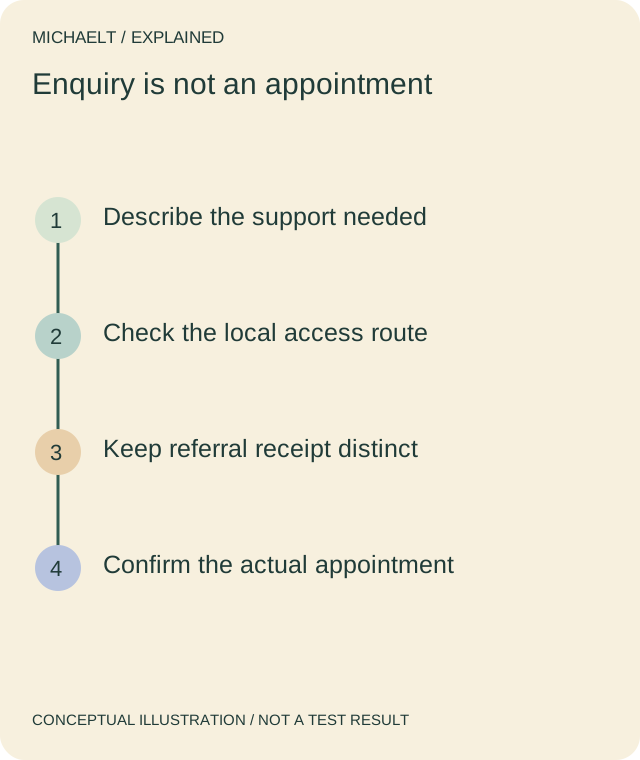
Read the drawing as text
A first enquiry, referral and confirmed appointment are separate events. Urgent needs take the appropriate urgent route.
Work through an example
A fictional person asks service S about help with daily difficulties. S confirms its area but says a referral is required. The record marks enquiry answered, referral not yet made and appointment not confirmed. The next action is to ask the appropriate referring professional. No waiting time, diagnosis, clinical outcome or real service availability is invented.
Illustrative example; figures, people and organisations in the worked record are fictional.
The example record
Need
- Evidence
- Private description in own words
- Next question
- What support am I asking about?
Route
- Evidence
- S requires a referral
- Next question
- Who can make it?
Appointment
- Evidence
- Not confirmed
- Next question
- Format and access arrangements?
Change
- Evidence
- Relevant contact retained
- Next question
- Which route if urgency changes?
Download blank worksheet (.csv) ↗Download worked example (.csv) ↗
Keep your own record
Use the result within its scope
Use this as an enquiry aid, not an assessment. The clinician or service determines the appropriate next step with you. Availability, eligibility and referral arrangements must be checked for the actual service and date.
Reference sources
Earlier articles on this subject
- All That You Need To know About Mental Health Awareness ↗ — 2021-01-07, Maria Baldwin.
- Drug Rehab Center In New Jersey for Painkiller Addictions ↗ — 2021-07-23, Maria Baldwin.