Identify the actual offer
Retain the lender’s legal identity, offer date, loan type, currency and applicable jurisdiction. Mark whether the document is an illustration, application response or binding agreement under its actual terms. An old hard-money-lending advertisement does not establish current eligibility, approval or security requirements. Ask the lender and an appropriate qualified adviser about terms you do not understand before agreeing to borrowing.
Separate interest and APR
The CFPB explains that a US auto-loan Truth in Lending disclosure includes APR, finance charge, amount financed and total payments. APR reflects a broader annual cost measure than the interest rate alone. That named disclosure context is not a universal format for every business or property loan. Do not compare an interest-only headline with another offer’s APR as though they measure the same thing.
Reconcile the cash flows
Record when and how much money is actually received, which fees are paid separately, the payment schedule and any final balance. Use the same currency and explicitly stated periods. Keep fees deducted from proceeds distinct from fees added to the balance. Ask the provider to resolve an unexplained difference; do not silently adjust a disclosure to make a spreadsheet balance.
Keep simple totals in scope
You can add known payments and separately paid fees as an illustration of cash paid. That sum does not calculate APR or account for timing, variable rates, contingencies or every legal term. Retain collateral, default, early-repayment and other conditions for appropriate professional review. A lower simple total is not by itself a recommendation to choose a loan or broker.
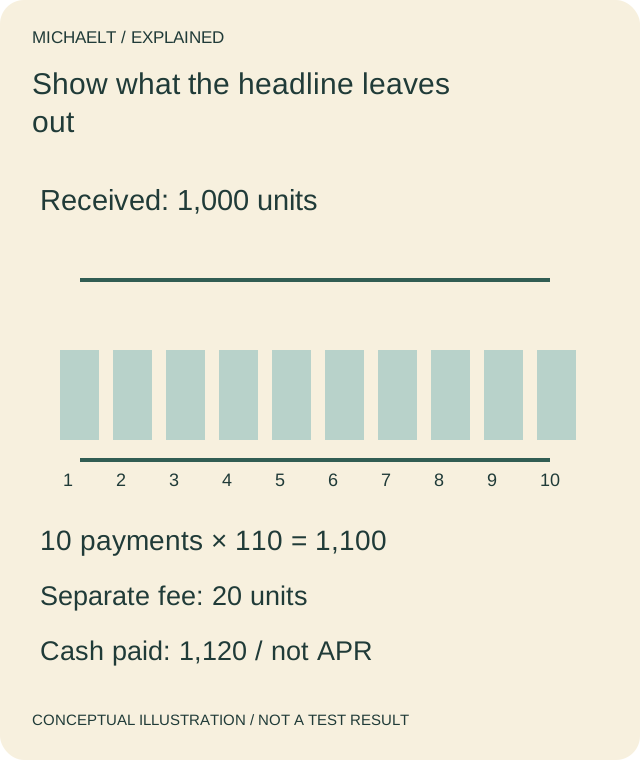
Read the drawing as text
The fictional ten payments total 1,100 units; a separate 20-unit fee makes cash paid 1,120. This addition does not calculate APR.
Work through an example
A fictional loan gives the borrower 1,000 units, requires ten payments of 110 and a separate upfront fee of 20. Scheduled payments total 1,100; including the separate fee gives 1,120 cash paid. This is not an APR calculation. If the fee were instead deducted from proceeds, the amount received would change and would need its own clear record.
Illustrative example; figures, people and organisations in the worked record are fictional.
The example record
Money received
- Evidence
- 1,000 units
- Next question
- Fee deducted or separate?
Scheduled payments
- Evidence
- 10 × 110 = 1,100
- Next question
- Exact timing and final balance?
Separate fee
- Evidence
- 20 units
- Next question
- Already included elsewhere?
Simple cash paid
- Evidence
- 1,120 units
- Next question
- Not an APR calculation
Download blank worksheet (.csv) ↗Download worked example (.csv) ↗
Keep your own record
Use the result within its scope
Use actual lender disclosures and qualified advice for the specific loan. The worked addition is a document-reading exercise, not a credit recommendation, approval prediction or calculation of a legally required rate.
Reference sources
Earlier articles on this subject
- Everything About Hard Money Lenders in California ↗ — 2021-03-02, Maria Baldwin.
- Understanding About Car Financing ↗ — 2022-06-09, Maria Baldwin.