Extract one claim you can actually check
Copy a short precise claim into a private note and keep the URL, publisher and date. Separate a claim about an ingredient from one about a named product, dose, population or condition. A phrase such as supports wellness may not say what measurable result is promised. A scientific-sounding name, impressive percentage or reference to unnamed researchers is a lead to investigate, not evidence by itself.
Follow the citation to the actual source
Look for the original study, regulator notice or relevant public-health guidance. Check that the linked page really concerns the same product and claim. Record whether you found a study, an expert explanation, an advertisement or merely another page repeating the headline. If the citation cannot be found, say not located; do not invent the journal, authors or result. Preserve the original date rather than making an old claim current by changing its year.
Read what kind of evidence it is
Record who or what was studied, what comparison was made and what outcome was measured. A laboratory observation, observational association and clinical trial answer different questions. A small or specific study does not automatically establish a result for every person. Ask what was not tested. Seek an appropriately qualified professional’s interpretation when the answer affects health; this sheet does not teach you to diagnose a condition or select a treatment.
Keep research and permission distinct
A published paper or trial listing is not the same thing as regulatory approval for a particular product and use. FDA’s dated regenerative-medicine warning illustrates that distinction and warns about unapproved products. Use the current regulator for the actual product and jurisdiction; the 2021 warning is not a complete 2026 list of approved therapies. Do not replace prescribed care, change a dose or attempt a procedure on the strength of a marketing claim.
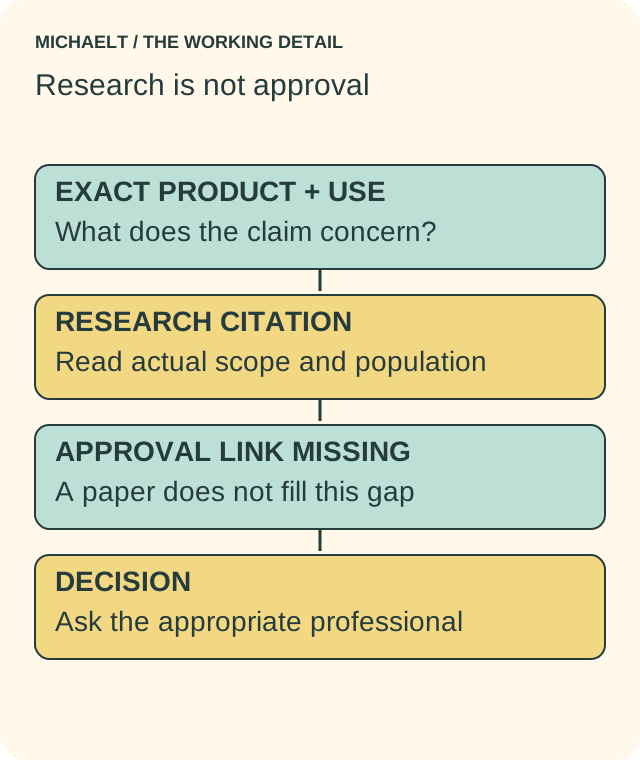
Read the drawing as text
Exact product and use must connect to the claim, relevant evidence and the actual regulator record. A supplied research citation does not fill a missing approval link.
Work through an example
A fictional advertisement says a stem-cell product is approved because a related therapy appeared in a research paper. The reader records the paper as research and asks for the exact product, intended use and regulator record. Approval remains unverified. The example does not declare every cell therapy ineffective or recommend any treatment; it identifies a missing link in the evidence.
Illustrative example; figures, people and organisations in the worked record are fictional.
The example record
Product and use
- What was found
- Not identified precisely
- Conclusion permitted
- Ask for exact identifiers
Paper
- What was found
- Research citation supplied
- Conclusion permitted
- Read its actual question
Regulatory approval
- What was found
- No matching record supplied
- Conclusion permitted
- Still unverified
Personal decision
- What was found
- Outside this worksheet
- Conclusion permitted
- Qualified advice required
Download blank worksheet (.csv) ↗Download worked example (.csv) ↗
Keep your own record
Use the result within its scope
A useful note can end with uncertainty. Absence of a citation does not authorise a diagnosis, while the presence of one does not settle clinical suitability. Keep both limits visible when sharing an explanation.
Reference sources
Earlier articles on this subject
- How Does A Bacteria Cause Gum Disease? ↗ — 2022-09-01, Maria Baldwin.
- Everything You Need To Know About Regenerative Medicine ↗ — 2022-09-21, Maria Baldwin.
- Get Stem Cell Therapy to Stop Aging ↗ — 2021-10-21, Maria Baldwin.
Continue with a related task
Track a medicine notice by date, formulation and jurisdiction
Use the ranitidine record to see why an older withdrawal notice and a later formulation-specific approval must retain their dates.
Keep both dated records
FDA’s earlier ranitidine material concerns the 2020 withdrawal. On 24 November 2025 FDA announced approval of reformulated ranitidine tablets. Preserve both events rather than changing the old notice’s year or repeating it as a blanket current statement about every product. The later announcement concerns its named formulation and US regulatory context, not every package sold under a similar name worldwide.
Match the actual product and question
Record the name, formulation, country and notice date relevant to the product being discussed. Ask a pharmacist or treating professional which current information applies to an individual’s actual medicine. An ingredient name alone cannot resolve a mismatch between an old notice and a reformulated product. Keep availability, regulatory status and personal suitability as separate questions.
Do not turn the timeline into instructions
FDA’s 2025 announcement directs patients to consult their healthcare providers before switching medicines. This example explains document scope and dates; it does not recommend starting, stopping, switching or storing an individual medicine according to a generic web summary. Use the actual current label and qualified advice. If the package or source cannot be identified, retain the uncertainty rather than declaring all versions safe or all versions banned.
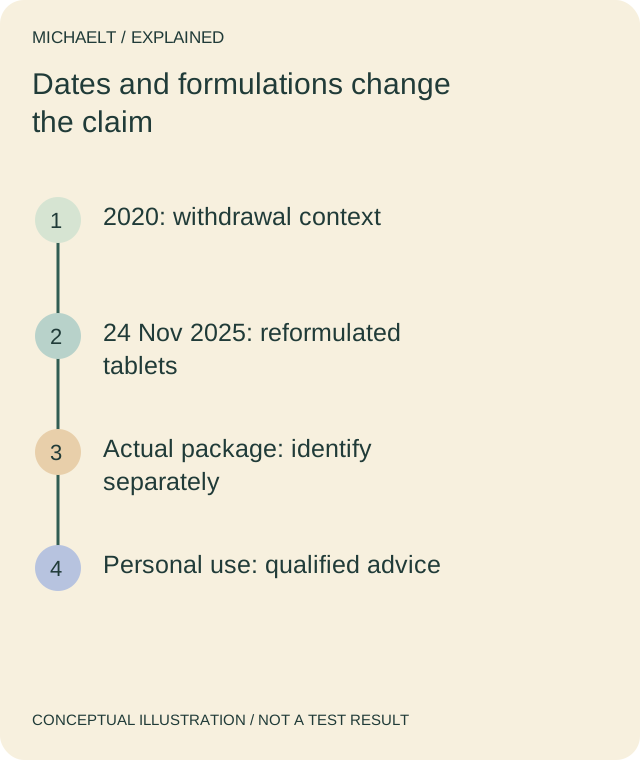
Read the drawing as text
The two FDA records concern different dated events. The 2025 approval does not identify a hypothetical package or instruct an individual to switch medicines.
Work through an example
An illustrative reading record contains two real FDA event dates: 2020 withdrawal context and 24 November 2025 reformulated-tablet approval. A hypothetical package has not been identified, so applicability remains unanswered. The chronology corrects an overbroad headline without making a treatment recommendation. No person, package, prescription or clinical outcome is assessed.
Illustrative example; figures, people and organisations in the worked record are fictional.
The example record
Earlier event
- Evidence
- 2020 withdrawal context
- Next question
- Keep historical date
Later event
- Evidence
- 24 November 2025 approval
- Next question
- Reformulated tablets / US
Actual product
- Evidence
- Not identified in example
- Next question
- Formulation and jurisdiction?
Personal use
- Evidence
- Qualified professional question
- Next question
- No switch instruction supplied
Download blank worksheet (.csv) ↗Download worked example (.csv) ↗
Keep your own record
Use the result within its scope
A newer record can change how a broad claim should be phrased while leaving an individual product question unresolved. Keep the primary sources and seek qualified advice for actual medicine use.
Reference sources
- FDA: approval of reformulated ranitidine, 24 November 2025 ↗
- FDA: questions and answers about the earlier ranitidine withdrawal ↗
Earlier articles on this subject
- Buying Acid Reflux Medication Over The Counter ↗ — 2021-04-28, Maria Baldwin.
- Symptoms for Acid Reflux ↗ — 2021-07-14, Maria Baldwin.