

Identify the device and data field
Keep the exact device, software context and field name with the number. A dashboard may combine sensor observations, arithmetic and a modelled outcome. A generic best-simulator article does not establish which is which. Read the actual manufacturer’s definition and mark an unclassified field as unknown. Do not fill gaps from a user-forum assertion or another device’s specifications.
Recognise a derived quantity
Garmin’s Approach G82 manual defines smash factor as ball speed divided by club-head speed. That definition provides a clear arithmetic example: two input speeds produce a dimensionless ratio when expressed on the same basis. It does not establish how every other Garmin model obtains each input, and it does not make a ratio a direct measurement of distance or future performance.
Keep modelled outcomes conditional
A simulated trajectory or distance can depend on settings and assumptions as well as inputs. Retain the relevant manufacturer explanation and session conditions before comparing results. A realistic course picture cannot establish that a ball travelled that real-world distance. This reading exercise supplies no swing technique, calibration procedure or claim that one launch monitor is accurate for every setting.
Compare the same field honestly
Use the same units, definition and context when comparing two entries. Keep changes in software, settings or session conditions visible. A number with more decimal places is not automatically more accurate. If the manufacturer does not explain whether a field is directly measured or derived, ask rather than assigning it a category from its name alone.
Read the drawing as text
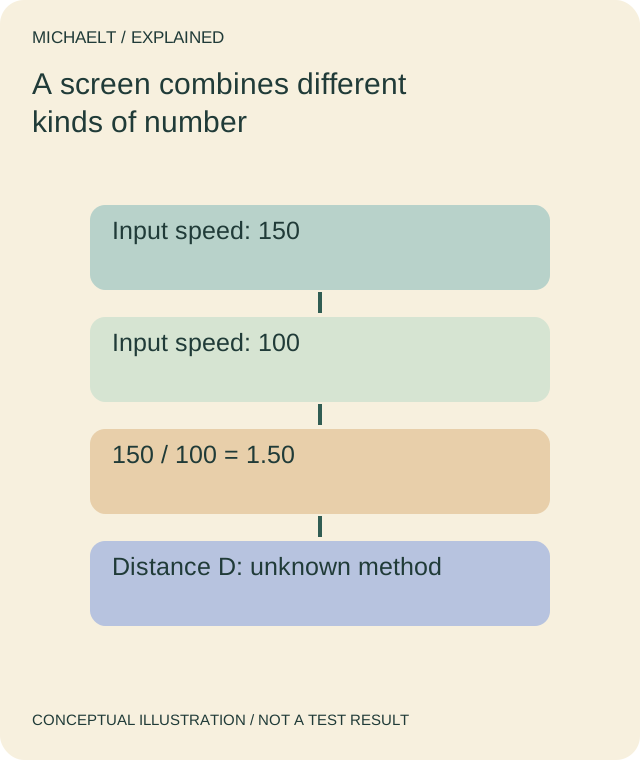
Two fictional speed inputs produce a defined ratio of 1.50. The separately displayed distance remains unclassified until its method is documented.
Work through an example
In a fictional record, ball speed is 150 units per hour and club-head speed is 100 of the same units. The defined ratio is 150 / 100 = 1.50. A separately displayed distance D is left unclassified because its calculation method has not been supplied. Neither the ratio nor D proves a real ball flight, skill improvement or tested equipment accuracy.
Illustrative example; figures, people and organisations in the worked record are fictional.
The example record
Inputs
- Illustrative evidence
- 150 and 100 in the same speed unit
- Meaning or next step
- Retain source and definition
Derived ratio
- Illustrative evidence
- 150 / 100 = 1.50
- Meaning or next step
- Dimensionless arithmetic
Distance D
- Illustrative evidence
- Method not supplied
- Meaning or next step
- Do not label directly measured
Comparison
- Illustrative evidence
- Same field and conditions
- Meaning or next step
- No improvement or accuracy claim
Download blank worksheet (.csv) ↗Download worked example (.csv) ↗
Keep your own record
Use the result within its scope
Read the actual model’s documentation and preserve uncertainty. This exercise explains data provenance; it does not endorse equipment, validate a simulator or predict a golfer’s results.
Reference sources
Earlier articles on this subject
- The Most Effective Playing Golf Simulator ↗ — 2022-04-07, Maria Baldwin.