
Read the stated identifiers
Copy the exact bar description, stated mass, unit, fineness and issuer or refiner identifier from the document you are examining. Keep the document date and provenance. A stock photograph, attractive finish or familiar logo cannot establish that the document belongs to a particular physical object. Do not buy, sell or authenticate an item solely from this worksheet.
Keep the unit explicit
Use one mass unit throughout a calculation. Grams, kilograms and troy ounces are different units; an unexplained ounce label is not sufficient. If a conversion is needed, retain the authoritative conversion reference and show the calculation separately. This example stays in grams to avoid hiding a unit conversion inside the result. Record whether a mass is stated or independently measured.
Apply fineness as a fraction
Fineness expressed in parts per thousand can be written as a fraction of 1,000. For the illustrative arithmetic, multiply the stated gross mass by that fraction. LBMA technical specifications provide a primary source for understanding fineness in its Good Delivery context; they do not make every small retail bar a Good Delivery bar. Keep the standard’s actual scope separate from the calculation.
List what the result cannot settle
Record the documents needed to resolve object identity, authenticity and any professional assessment. A fine-metal content calculation does not supply a buyback price, dealer spread, fees or an investment return. Ask an appropriate qualified professional about the physical item and transaction. Do not describe an unverified certificate as an independent assay or predict future gold prices from a historical article.
Read the drawing as text
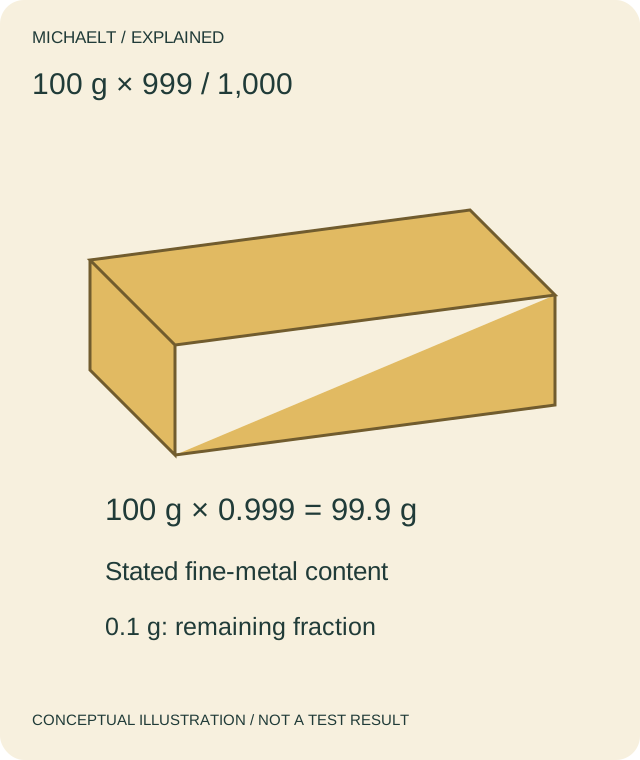
The fictional 100 g gross mass comprises calculated 99.9 g fine metal and 0.1 g other mass at stated fineness 999. This is not an assay.
Work through an example
A fictional document states gross mass 100 g and fineness 999 parts per thousand. The arithmetic is 100 × 999 / 1,000 = 99.9 g of stated fine-metal content. If the document refers to a different object, the arithmetic remains correct but says nothing about the object being offered. No real bar has been weighed, assayed, authenticated or valued.
Illustrative example; figures, people and organisations in the worked record are fictional.
The example record
Gross mass
- Evidence
- 100 g stated
- Next question
- Which object and document?
Fineness
- Evidence
- 999 / 1,000
- Next question
- Stated rather than tested
Calculated content
- Evidence
- 99.9 g
- Next question
- Same gram unit retained
Transaction
- Evidence
- No offer supplied
- Next question
- Authentication and price separate
Download blank worksheet (.csv) ↗Download worked example (.csv) ↗
Keep your own record
Use the result within its scope
Label the result as calculated from stated inputs. Retain both inputs and their source; do not present the output as a laboratory result, current market value or recommendation to invest.
Reference sources
Earlier articles on this subject
- Basic Things About Gold Bars ↗ — 2021-05-14, Maria Baldwin.