Begin with the actual research question
The Yale companion to Venkadesan and colleagues’ 2020 Nature study explains research on foot stiffness and the transverse tarsal arch. The authors distinguish the arch across the foot’s width from the better-known longitudinal arch. Their work challenges a one-arch explanation of stiffness; it is not support for the earlier source’s claim that the relevant transverse arch does not exist.
Use an ordinary sheet as an analogy
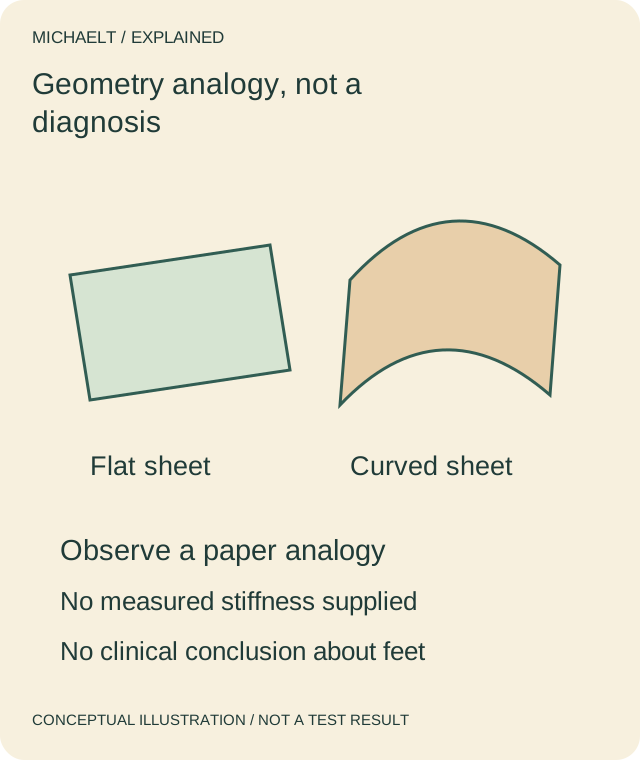
On a clear table, take an ordinary uncut sheet of paper. Compare its shape when held flat with the shape when you gently curve it across its width. Observe how readily the free portion bends under its own weight, without adding loads or treating your hands as calibrated instruments. The authors use a similar curved-bill analogy to explain geometric stiffness. Do not involve a person’s foot in this activity.
Write observations rather than invented results
Record the sheet, orientation and what you actually noticed. If your attempt does not show an obvious difference, record that rather than assigning a percentage from a published experiment. Paper geometry is not a complete anatomical model: living tissues, movement and loading are more complex. A conceptual sketch should not be captioned as a measured test or a replica of the researchers’ experiment.
Keep the clinical boundary visible
The Yale authors explicitly state that they did not study foot health and provide no data telling people how to manage flatfoot disorders or surgery. Do not choose orthotics, exercise or treatment from a paper demonstration or a static foot photograph. Bring symptoms and individual functional questions to an appropriate qualified professional. A mechanism can be interesting without becoming a prescription.
Read the drawing as text
The flat and curved paper sketches illustrate a geometric idea. They are not anatomical measurements or evidence for an individual treatment.
Work through an example
A fictional notebook labels two sketches flat sheet and gently curved sheet. It records a qualitative observation, not a numerical stiffness result. Beside them it notes that the 2020 study concerns biomechanics and that clinical suitability remains outside the activity. No participant, foot measurement, orthotic, treatment or new research finding is represented.
Illustrative example; figures, people and organisations in the worked record are fictional.
The example record
Research
- Illustrative evidence
- 2020 transverse-arch study
- Meaning or next step
- Keep its actual question and date
Analogy
- Illustrative evidence
- Flat versus gently curved paper
- Meaning or next step
- Not a foot experiment
Observation
- Illustrative evidence
- Qualitative note only
- Meaning or next step
- No invented percentage
Clinical question
- Illustrative evidence
- Not studied in the activity
- Meaning or next step
- Qualified individual assessment
Download blank worksheet (.csv) ↗Download worked example (.csv) ↗
Keep your own record
Use the result within its scope
Use the activity to understand an idea about geometry. It cannot diagnose foot function, validate an orthotic or reproduce the study’s findings. Preserve the difference between an analogy, a research experiment and individual healthcare.
Reference sources
- Venkadesan and colleagues: Arched Foot, companion to Nature research, 2020 ↗
- Venkadesan and colleagues: Stiffness of the human foot and evolution of the transverse arch, Nature 2020 ↗
Earlier articles on this subject
- How does the arch of the foot work? ↗ — 2021-07-09, Maria Baldwin.
- Flat Feet? No Problem With Custom Foot Orthotics ↗ — 2021-03-13, Maria Baldwin.