State the purpose privately
Write the questions you hope to discuss in neutral language, separating agreed facts from disputed points and preferences. Keep children’s identities, financial documents and allegations out of public templates. An agenda can help explain the enquiry; it does not decide who is right, resolve legal rights or establish what agreement should be reached. Use appropriate professional support for your situation.
Ask about suitability first
GOV.UK describes an initial mediation information and assessment meeting in the England-and-Wales family context, with exceptions in some circumstances. Do not turn that into a worldwide requirement or an instruction to meet an ex-partner together. Tell the professional privately about safety, accessibility or communication concerns and ask which process is appropriate. A generic settlement article cannot make that assessment.
Clarify the actual process
Ask about the mediator’s role, professional status, individual assessment, format, costs, information handling and the next administrative step. Keep a request for information distinct from agreement to participate. Ask how any proposed outcome would be documented and when independent legal advice is needed. Do not assume a universal confidentiality rule, guaranteed settlement rate or automatic legal effect for every discussion.
Record a safe next contact
Keep the professional’s actual answer and the question that remains open. Follow the relevant local support or urgent route when safety requires it rather than waiting to complete an agenda. If mediation is unsuitable, ask the appropriate qualified professional about alternatives. The downloadable example is a neutral enquiry record, not a separation agreement, court document or recommendation to proceed.
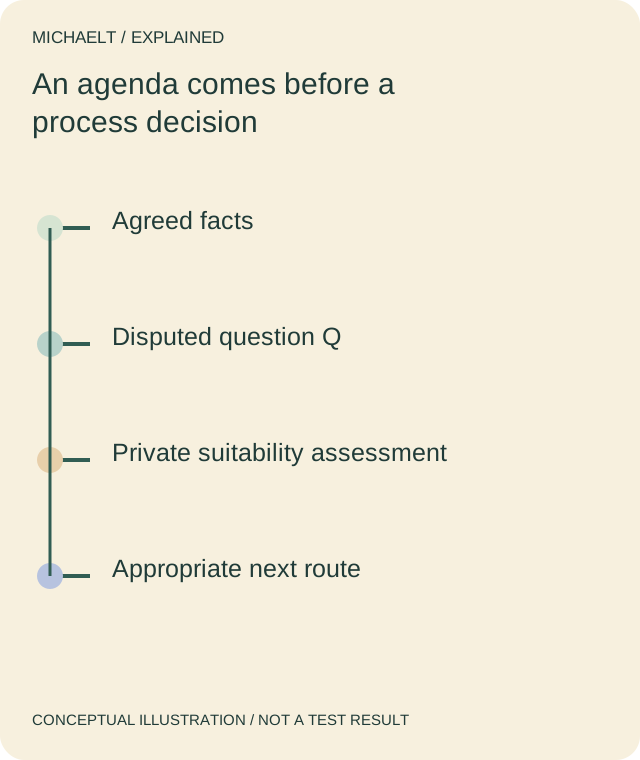
Read the drawing as text
Agreed facts and disputed questions inform a private professional enquiry; suitability and the next route remain to be assessed.
Work through an example
A fictional person lists question Q about an arrangement, identifies what is agreed and asks mediator M about an initial individual assessment. Suitability has not been assessed, so the record remains enquiry pending. No joint meeting is booked and no legal agreement is implied. The next step is M’s appropriate response to the private enquiry, not an assumed obligation to negotiate.
Illustrative example; figures, people and organisations in the worked record are fictional.
The example record
Question
- Evidence
- Q stated neutrally
- Next question
- What help is being requested?
Facts
- Evidence
- Agreed / disputed kept separate
- Next question
- No decision on rights
Process
- Evidence
- Initial assessment requested
- Next question
- Suitability unanswered
Next contact
- Evidence
- Appropriate professional route
- Next question
- Format and support to clarify
Download blank worksheet (.csv) ↗Download worked example (.csv) ↗
Keep your own record
Use the result within its scope
Use current local rules and individual professional advice. A prepared agenda does not establish that mediation is suitable, safe or mandatory, and it does not guarantee agreement or replace legal advice.
Reference sources
Earlier articles on this subject
- Use of Mediation in Divorce Settlement ↗ — 2021-09-06, Maria Baldwin.