Start with the exact vehicle
Record the make, model, relevant model year and feature name from the actual vehicle documentation. Ask about any configuration or version distinction that affects the feature. A brand-level advertisement or a photograph of a dashboard cannot establish what is fitted to a particular vehicle. Keep the manual and manufacturer confirmation with the actual identifiers.
Distinguish the function
NHTSA explains driver-assistance technologies and how their functions differ. A warning, intervention and assistance with a driving task are not interchangeable descriptions. Read the exact feature’s purpose and limitations rather than promoting a marketing name into a claim of autonomous driving. A feature list does not establish that the vehicle can perform the whole driving task without a driver.
Read responsibilities and conditions
Use the actual manufacturer’s instructions for supervision, attention, permitted conditions and limitations. Ask the manufacturer or appropriate qualified service contact about unclear wording. Do not conduct a public-road experiment to discover the limits or disengage safeguards to make a feature work. The record is for understanding documentation, not an operating or testing procedure.
Keep claims and evidence aligned
Write the narrow description supported by the manual and identify the unanswered question. Distinguish a conceptual automation diagram from a claim that a specific product is available or authorised in your location. Do not copy a historical forecast into a 2026 purchasing promise. Use current manufacturer and local regulatory information for an actual decision.
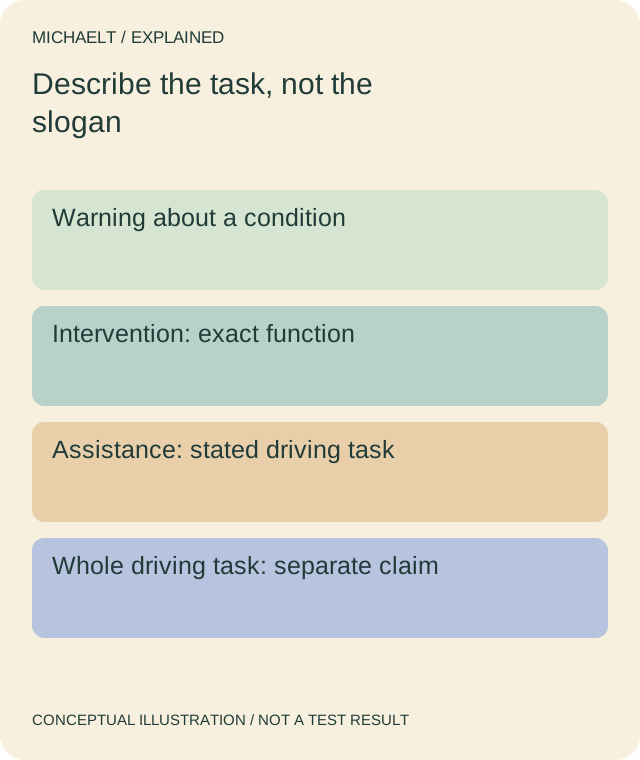
Read the drawing as text
Warning, intervention and driving assistance must retain their exact documented functions. None is automatically a claim of self-driving.
Work through an example
A fictional manual describes feature F as providing a warning under stated conditions. An advertisement calls the vehicle autonomous, but no matching documentation supports that broader claim. The reader records the warning function and asks the manufacturer about the mismatch. No vehicle is driven, tested or rated, and no feature is declared suitable for unsupervised operation.
Illustrative example; figures, people and organisations in the worked record are fictional.
The example record
Vehicle
- Evidence
- Exact configuration and manual
- Next question
- Not a brand-wide assumption
Feature F
- Evidence
- Warning function stated
- Next question
- What task is actually described?
Conditions
- Evidence
- Actual manual required
- Next question
- Driver responsibilities retained
Broader claim
- Evidence
- Autonomous in advertisement
- Next question
- Matching evidence not supplied
Download blank worksheet (.csv) ↗Download worked example (.csv) ↗
Keep your own record
Use the result within its scope
Follow the actual vehicle instructions and applicable rules. A documentation comparison does not certify automated capability, authorise unattended driving or establish safety performance for a specific vehicle.