Identify what is actually described
Record the medicine’s exact identity, formulation, preparation context and jurisdiction from the real professional information. Personalised, natural and bioidentical are not interchangeable with a named regulator record. A hormonal-treatment advertisement or a saliva-test claim cannot establish which product is being supplied, why it is appropriate or what evidence applies to an individual.
Read the US distinction accurately
FDA explains that compounded drugs are not FDA-approved and that compounding can meet important patient needs when an approved medication is not medically appropriate. It also distinguishes a compounded preparation from an FDA-approved generic. Those are different regulatory concepts, not a statement that every customised preparation is unlawful or that every approved product is suitable for every patient.
Keep the person and the product in separate records
A professional’s identity or a facility’s registration does not itself provide FDA approval of an individual finished preparation. Ask the treating clinician or pharmacist to explain the actual product, reason for its preparation, supporting information and relevant instructions. Do not infer safety, effectiveness, cancer prevention or a need for hormone replacement from marketing language or an unrelated ingredient approval.
Prepare a focused professional question
Retain the actual label and prescribing information privately and ask which status and evidence apply to this preparation. Keep an unanswered identity or status field open. Do not start, stop, switch or change a medicine to make a worksheet agree with an internet page. No hormone, testing method, dose, application route or individual treatment is recommended here.
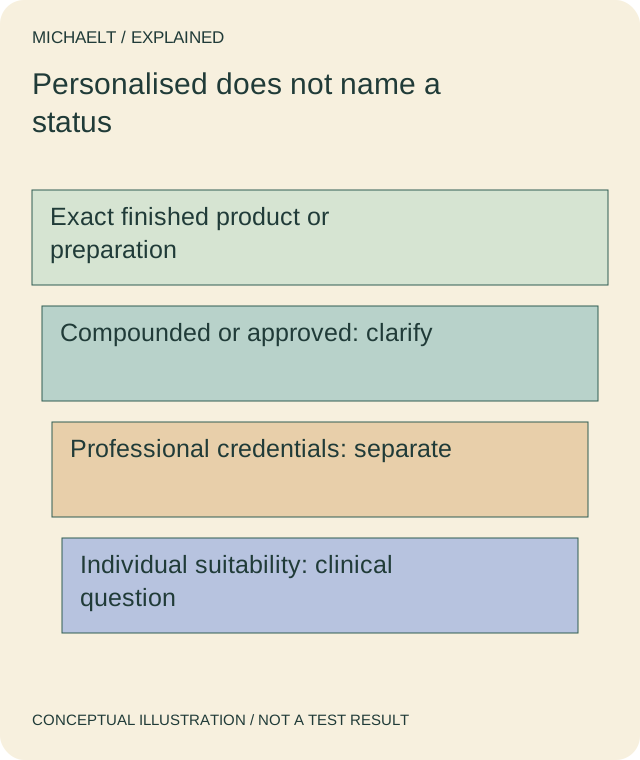
Read the drawing as text
A personalised description and professional credentials do not establish the regulatory status or clinical suitability of a particular preparation.
Work through an example
A fictional advertisement calls preparation P personalised and lists a professional’s credentials. The reader asks the pharmacist to identify P and explain whether it is an approved finished product or a compounded preparation. The credentials do not fill the product-status field. No actual medicine, pharmacy, prescription, legal compliance or clinical outcome is assessed.
Illustrative example; figures, people and organisations in the worked record are fictional.
The example record
Identity
- Illustrative evidence
- Preparation P not yet identified
- Meaning or next step
- Exact formulation and context?
Description
- Illustrative evidence
- Personalised in advertisement
- Meaning or next step
- Not an approval record
Professional
- Illustrative evidence
- Credentials supplied
- Meaning or next step
- Separate from product status
Question
- Illustrative evidence
- Clinician/pharmacist clarification
- Meaning or next step
- No treatment change from worksheet
Download blank worksheet (.csv) ↗Download worked example (.csv) ↗
Keep your own record
Use the result within its scope
Use the actual regulator and qualified professional advice for the jurisdiction and medicine. This comparison explains document roles; it cannot decide treatment suitability, approve a preparation or determine the legality of an individual supply.