Separate the two uses of the name
NIDA’s 2022 teaching material uses bath salts as a slang term associated with synthetic cathinones. A 2013 JAMA explanation distinguishes those substances from Epsom salts in ordinary bath products. These are dated educational references, not a current catalogue of products. The shared words do not make the substances equivalent or support a claim that one can be substituted for the other.
Read identity rather than appearance
For an ordinary labelled product, retain the actual manufacturer, product name, ingredients and intended-use information. A white powder, decorative packaging or a handwritten name cannot establish chemical identity. An unlabelled or suspicious substance should remain unidentified; do not smell, taste, mix or test it to determine which meaning of the words applies. Use the appropriate local professional or authority route.
Keep claims separate from the category
Even a correctly identified bath product is not thereby a treatment for infection, cancer, pain or another condition. Follow the real product information and seek appropriate qualified advice about health concerns. An ingredient’s name or the word natural does not establish suitability for an individual. This page supplies no bathing recipe, medicinal dose or instructions for drug use.
Write an honest description
When sharing information, say which meaning and source you are discussing. If product identity cannot be established, record that uncertainty instead of labelling a substance safe, legal or therapeutic. If an exposure or symptoms have occurred, contact the appropriate local poison, clinical or emergency service promptly. Do not wait for an internet identification exercise or attempt to neutralise a substance yourself.
Read the drawing as text
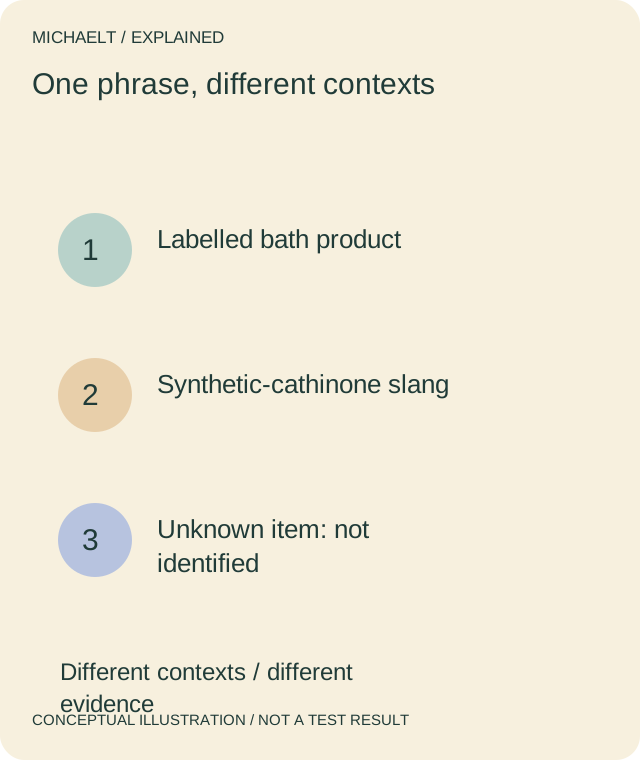
The same phrase can occur in unrelated product and drug-education contexts. An unknown item cannot be identified by the phrase or its appearance.
Work through an example
A fictional search returns a cosmetic product page and a dated educational article about synthetic cathinones. The reader stores them as two different contexts, not two descriptions of the same item. An unrelated unlabelled container remains unidentified. No substance is purchased, handled, used, tested or declared lawful in the example.
Illustrative example; figures, people and organisations in the worked record are fictional.
The example record
Phrase
- Illustrative evidence
- Bath salts
- Meaning or next step
- Name alone is ambiguous
Context A
- Illustrative evidence
- Labelled bath product
- Meaning or next step
- Actual identity still matters
Context B
- Illustrative evidence
- Dated synthetic-cathinone education
- Meaning or next step
- Different category
Unknown item
- Illustrative evidence
- Unlabelled container
- Meaning or next step
- Do not infer identity or experiment
Download blank worksheet (.csv) ↗Download worked example (.csv) ↗
Keep your own record
Use the result within its scope
Names are a starting point for reading, not proof of composition or safety. Use verified product information and appropriate local help; this page does not classify an unknown substance or facilitate obtaining drugs.
Reference sources
- NIDA: Mind Matters teacher guide, 2022, synthetic cathinones section ↗
- JAMA: Bath Salts Abuse, 23 January 2013 ↗
Earlier articles on this subject
- How Bath Salts Can Help You ↗ — 2021-08-28, Maria Baldwin.