Keep one vehicle identity throughout
Start with the vehicle identification number, make, model and the dealer’s actual listing. Match the identifiers across the quote, history record, inspection and proposed contract. A familiar model name can cover different vehicles and conditions. Mark an identifier missing rather than borrowing one from a similar advertisement. This guide uses US FTC dealer guidance as an example; private sales and other jurisdictions have different requirements.
Read the warranty position in writing
Obtain the actual Buyers Guide where applicable and ask for written clarification of promises about warranty or an as-is sale. Keep any service contract distinct from the dealer warranty and from the seller’s advertising. The FTC explains that Maine and Wisconsin use their own guide versions. Do not assume a universal right to return a used car within three days or turn a spoken assurance into a contractual remedy.
Separate history from inspection
The FTC distinguishes a vehicle history report from an independent mechanical inspection. Ask about an appropriate independent inspection and keep its vehicle identifier, scope, date and outstanding findings. A clean-looking cabin, a history report or the word certified is not the same evidence. Leave inaccessible or untested areas unresolved. This page does not instruct a road test, mechanical diagnosis or a DIY safety inspection.
Compare the complete written price
Request the out-the-door price with each charge identified, and ask which proposed add-ons are optional. Keep financing terms and total credit cost separate from the vehicle’s cash price. Review differences between the original quote and final documents before signing. Retain the current local consumer guidance for questions about rights, disputes and contractual terms rather than using a generic online template to decide them.
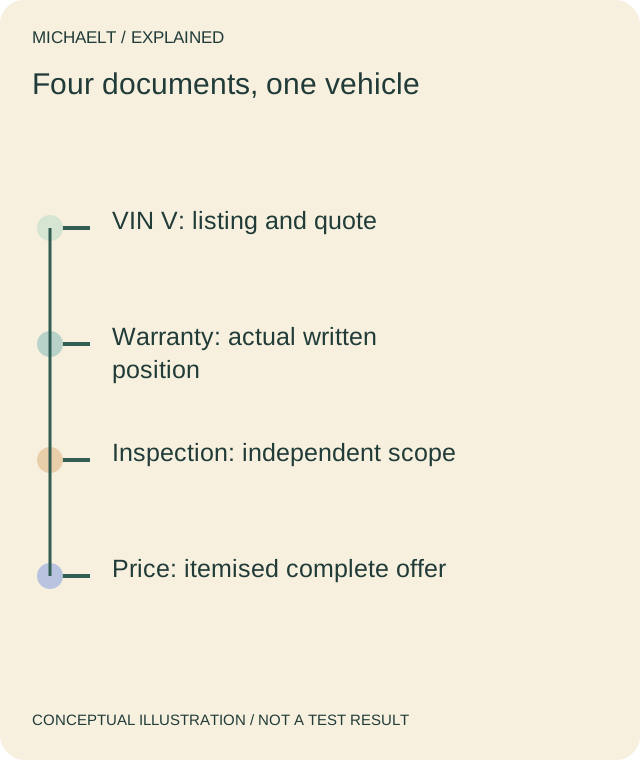
Read the drawing as text
The same vehicle identifier connects four different kinds of evidence. One document does not substitute for the others.
Work through an example
A fictional offer V has a matching VIN on its quote and history report. The independent inspection is still pending, while a separately priced add-on appears only on a later document. The buyer marks those two questions open and asks for a revised complete quote. No actual vehicle condition, purchase saving or legal outcome is asserted.
Illustrative example; figures, people and organisations in the worked record are fictional.
The example record
Vehicle
- Identifier or state
- VIN V on quote/history
- Question
- Match all documents
Warranty
- Identifier or state
- Actual Buyers Guide
- Question
- Written terms
Inspection
- Identifier or state
- Independent report pending
- Question
- Do not replace with history
Price
- Identifier or state
- Add-on newly listed
- Question
- Request complete written total
Download blank worksheet (.csv) ↗Download worked example (.csv) ↗
Keep your own record
Use the result within its scope
A complete bundle supports an informed enquiry. It cannot guarantee reliability, determine a vehicle’s safety or replace advice about the actual agreement.
Reference sources
Earlier articles on this subject
- Great Advice On Used Car ↗ — 2021-09-29, Maria Baldwin.