Find the actual claim
Record the product identifier, label wording and the source of its UPF statement. Do not infer a rating from a dark colour, high price or a generic summer-clothing description. ARPANSA explains sun protection through clothing and testing. Keep the exact product’s evidence with it; a test for one fabric does not automatically describe another garment sold under the same brand.
Ask what the evidence covers
Identify whether the supplied information concerns a fabric, garment or other stated sample and which conditions it describes. Retain the standard or test reference where given and ask the maker about an unexplained claim. This page does not provide a home UV test or calculate safe exposure time. A catalogue photograph cannot verify a protection rating.
Consider actual coverage separately
Record the areas covered by the chosen garment in its intended use, following appropriate sun-protection guidance. A rated material cannot protect an uncovered area. Ask about the maker’s care and use conditions rather than assuming an item performs identically when stretched, wet, worn or altered. Keep a scarf’s style preference separate from an unsupported claim that every scarf provides adequate protection.
Keep the comparison limited
Use the evidence to ask a clear purchasing question and combine clothing with the appropriate broader sun-protection advice for the individual and conditions. Do not treat a worksheet as a medical assessment, an infant-care instruction or a guarantee against sun damage. If an exact rating or scope is missing, leave it unverified instead of converting a product category into a protection claim.
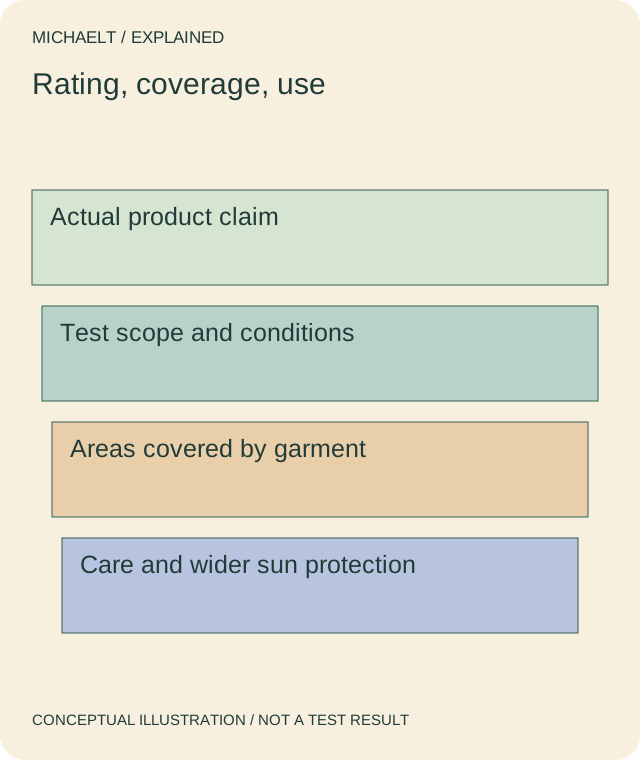
Read the drawing as text
A material’s rating, the garment’s coverage and actual use conditions are different parts of the comparison; colour alone supplies none of them.
Work through an example
A fictional product lists a fabric UPF claim, while a second item only says summer scarf. The buyer retains the first claim with its source and asks about the second. Both items still have separate coverage and use-condition questions. No rating, exposure allowance or protection result is assigned to a real photographed garment.
Illustrative example; figures, people and organisations in the worked record are fictional.
The example record
Product
- Evidence
- Exact identifier
- Separate question
- Same tested item?
Claim
- Evidence
- Actual UPF wording
- Separate question
- Source and conditions
Coverage
- Evidence
- Areas covered in use
- Separate question
- Uncovered areas remain
Care/use
- Evidence
- Maker’s directions
- Separate question
- Do not infer from colour
Download blank worksheet (.csv) ↗Download worked example (.csv) ↗
Keep your own record
Use the result within its scope
Follow current official sun-protection guidance and appropriate medical advice. A documented rating is not a personalised safe-exposure timer.
Reference sources
Earlier articles on this subject
- Good Things About A Summer Scarf ↗ — 2022-02-03, Maria Baldwin.
- Tips When Opting For Womens Swimwear ↗ — 2021-06-29, Maria Baldwin.
- Disney Bathing Suits: Complete Information ↗ — 2022-07-01, Maria Baldwin.
- Beach Dresses For Women ↗ — 2022-05-06, Maria Baldwin.