Identify the bike and jurisdiction
Record the exact model, manufacturer documentation and intended place of use. A marketplace image labelled 1,000 watts is not a complete technical description or proof of legality. The linked GOV.UK page explains the relevant EAPC rules in its stated context. Other countries and territories have different definitions and routes, so do not treat this example as a worldwide classification.
Keep the power terms explicit
Ask which figure is maximum continuous rated power and which, if any, is a peak marketing claim. GOV.UK’s EAPC conditions include a maximum continuous rated motor power of 250 W and cessation of electrical assistance above 15.5 mph, alongside the other requirements. Read the full current rules, including pedal and approval conditions; one power number does not settle the category.
Check the documentation rather than modifying it
Retain the actual manufacturer or importer information and ask the appropriate authority about an unresolved classification. Do not unlock a controller, alter an assistance limit or change a label to make a product appear to meet a rule. A compliant-looking sticker cannot establish the configuration of an actual bike or the legal consequences of a modification.
Keep use and purchasing questions separate
Once the category is clarified through the appropriate route, check the actual requirements for the place and activity. A category decision is not a mechanical safety inspection, an assessment of a rider’s ability or a guarantee about battery range. Follow current manufacturer safety guidance and relevant qualified advice. This page gives no installation, battery repair or power-upgrade instructions.
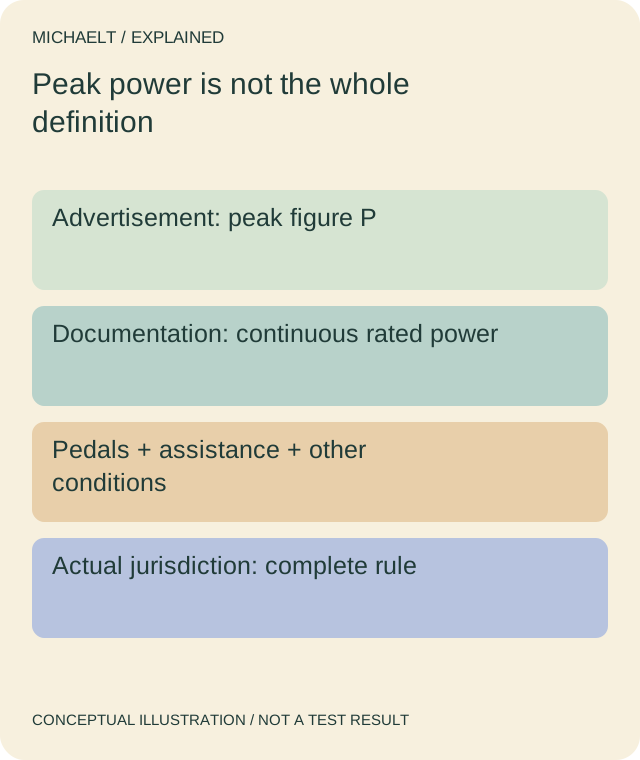
Read the drawing as text
An advertised peak value alone does not supply the continuous rating or satisfy all conditions of the applicable legal category.
Work through an example
A fictional advertisement states peak power P but omits continuous rated power. The buyer records that the legal-definition field is still unanswered and asks for the appropriate documentation. The headline alone is not used to declare the bike either an EAPC or an illegal vehicle.
Illustrative example; figures, people and organisations in the worked record are fictional.
The example record
Model
- Evidence
- Exact maker reference
- Question
- Same configuration?
Power
- Evidence
- Peak P advertised
- Question
- Continuous rating missing
Assistance
- Evidence
- Actual documented behaviour
- Question
- Read complete local rule
Classification
- Evidence
- Appropriate authority route
- Question
- Not decided by image
Download blank worksheet (.csv) ↗Download worked example (.csv) ↗
Keep your own record
Use the result within its scope
Check current official requirements for the actual jurisdiction. This is a source and terminology check, not a legal approval, roadworthiness certificate or riding instruction.
Reference sources
Earlier articles on this subject
- Few Technical Details About 1000w Electric Bikes ↗ — 2021-01-09, Maria Baldwin.