Collect the same document version
For each actual plan, retain the plan name, coverage period, applicable location and Summary of Benefits and Coverage, or SBC. HealthCare.gov explains that the SBC and Uniform Glossary help compare individual and job-based plans. Do not compare an old summary from one plan with a current sales headline from another. The linked source concerns the United States; other countries have different documents and rules.
Keep fixed payments and use-related costs apart
Put the premium and its period in one row. Record the deductible, copayment, coinsurance and out-of-pocket terms in their own rows using the document’s wording and glossary. Do not add these figures together as though every amount is a bill you will certainly pay. An annualised premium calculation can be useful arithmetic, but it is not a forecast of total costs or evidence of coverage.
Ask about the actual services you need
Use the relevant plan documents and confirmed provider information for network, medicines and service questions. Ask how the quoted terms apply to the specific situation and keep the answer’s date and source. Do not infer that a provider accepting an insurance card means every proposed service is covered or that a family plan has the same cost-sharing structure as an individual one. Record uncertain fields without guessing.
Treat examples as examples
The SBC contains standard coverage examples, not a personalised treatment plan or a guaranteed invoice. Check exclusions, limits and the documents the plan directs you to read. For a purchasing or eligibility decision, obtain appropriate qualified assistance and the plan’s actual answer. This worksheet does not estimate subsidies, prescribe a plan, calculate legal benefits or promise that all hospital bills will be paid.
Read the drawing as text
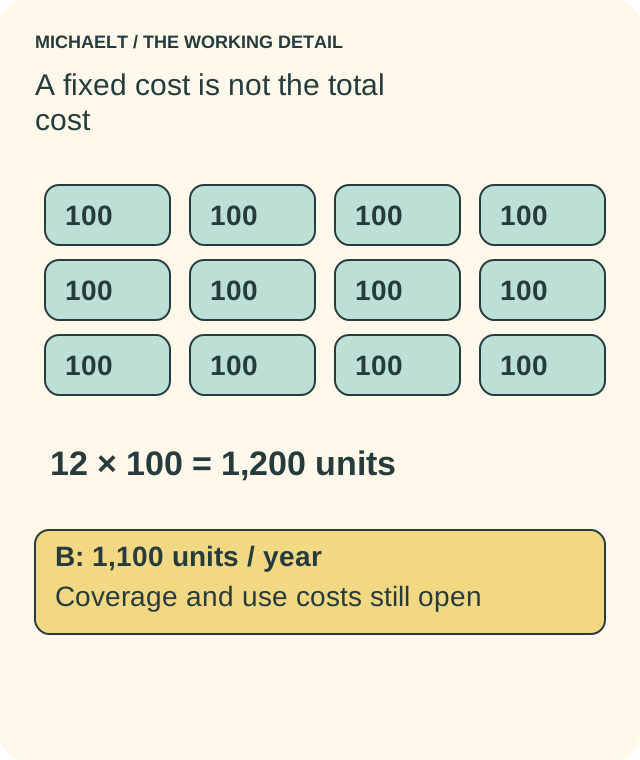
Illustrative A: 12 monthly payments of 100 units equals 1,200 units. B: 1,100 annually. Service coverage, network and cost sharing still need confirmation.
Work through an example
Fictional plan A quotes a premium of 100 units per month, so 12 unchanged monthly payments would total 1,200 units. Plan B quotes 1,100 units per year. The buyer still cannot conclude which costs less overall: service coverage, network and cost-sharing remain unconfirmed. The illustration is arithmetic with invented amounts, not a quotation or insurance recommendation.
Illustrative example; figures, people and organisations in the worked record are fictional.
The example record
Premium basis
- Example A
- 100 units / month
- Example B
- 1,100 units / year
Annualised fixed amount
- Example A
- 1,200 units if unchanged
- Example B
- 1,100 units
Cost-sharing terms
- Example A
- Read SBC and glossary
- Example B
- Read SBC and glossary
Actual service/network
- Example A
- Questions still open
- Example B
- Questions still open
Download blank worksheet (.csv) ↗Download worked example (.csv) ↗
Keep your own record
Use the result within its scope
Keep the actual SBC, glossary and written clarifications together. A lower fixed payment is not proof of lower total cost, appropriate coverage or eligibility. Do not use this example as personal medical, legal or financial advice.
Reference sources
Earlier articles on this subject
- Cut Your High Medical Costs With Health Insurance ↗ — 2021-10-20, Maria Baldwin.
- Top Reasons Why Group Insurance Is Great For You? ↗ — 2021-11-12, Maria Baldwin.
- How Does The Affordable Care Act Benefit People? ↗ — 2021-08-23, Maria Baldwin.
- Family Health Insurance: To Take Care Of Family ↗ — 2021-11-03, Maria Baldwin.
- Choosing Your Family Dental Care ↗ — 2021-10-29, Maria Baldwin.