
Describe the reported problem
Use the exact vehicle reference and the directly observed symptom, with relevant dates or circumstances. Keep a warning displayed or a noise heard separate from a guessed cause. Do not reproduce a fault by driving unsafely, opening systems or bypassing a warning. This sheet helps prepare the conversation with a qualified repairer, not diagnose fuel, braking, electrical or transmission faults.
Define the first authorised task
Ask what inspection or diagnostic work is proposed, how it is charged and what your approval covers. Keep the estimate, exclusions and any agreed limit with the record. California’s Bureau of Automotive Repair explains estimate and authorisation requirements in that jurisdiction. Use the applicable rules and actual agreement for your location rather than treating a California requirement as universal.
Make a repair proposal a new decision
When findings arrive, ask for the proposed work, parts basis, labour, complete price and any uncertainty in writing. Distinguish an explanation from permission to proceed. Record which person can approve a change and the provider’s confirmation of that instruction. A diagnostic booking does not automatically settle every subsequent repair; do not assume a parts recommendation establishes the fault without the appropriate assessment.
Compare completion with the approval
Keep the actual invoice, work record, relevant warranty terms and the provider’s handover instructions. Ask about work not matching the authorised scope. Record unresolved symptoms through the proper route rather than performing a risky demonstration for the worksheet. Payment, collection and a reported result are different events; none by itself is a universal certificate of vehicle safety.
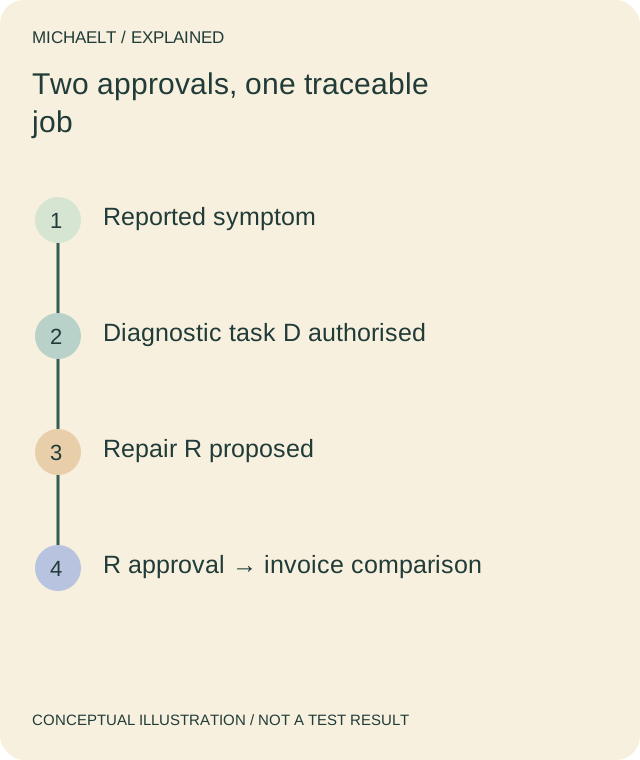
Read the drawing as text
Diagnosis and the later repair proposal are separate decisions. Keep the actual approval connected to the completed-work record.
Work through an example
A fictional booking authorises diagnostic task D. The workshop later proposes repair R and an additional part. The owner records the revised estimate and asks a question before approving R. The final invoice must be compared with the actual approval; the example does not invent a fault, a necessary repair or a guaranteed cure.
Illustrative example; figures, people and organisations in the worked record are fictional.
The example record
Symptom
- Document
- Literal report
- Decision
- No guessed diagnosis
Diagnosis D
- Document
- Initial scope and charge
- Decision
- Defined approval
Repair R
- Document
- Revised written proposal
- Decision
- Separate decision
Completion
- Document
- Invoice and handover
- Decision
- Compare with approval
Download blank worksheet (.csv) ↗Download worked example (.csv) ↗
Keep your own record
Use the result within its scope
Follow qualified advice, actual local requirements and the provider’s instructions. This page gives no repair method, performance modification or universal price ceiling.
Reference sources
Earlier articles on this subject
- Choosing the Right Transmission Repair Shop ↗ — 2022-06-29, Maria Baldwin.
- Why Should You Choose a Professional in Australia to Carry Out ECU Remapping? ↗ — 2021-01-22, Maria Baldwin.
- Why Do Cars Need Panelbeating Supplies ↗ — 2022-07-15, Maria Baldwin.
- Learn How To Use Paint Spray Gun ↗ — 2021-02-25, Maria Baldwin.
- Why It Is Important To Maintain Fuel Pump Of Your Car ↗ — 2022-04-06, Maria Baldwin.
- Reasons To Have Power Windows Repaired ↗ — 2022-07-23, Maria Baldwin.
- Tips for Vehicle Diesel Repairs ↗ — 2021-10-19, Maria Baldwin.
- Buying Commercial Truck Parts Online ↗ — 2022-03-07, Maria Baldwin.
- Car Servicing: Vital Tips and Suggestions for the Motorists ↗ — 2022-05-23, Maria Baldwin.
- Nudge Bar And Its Benefits ↗ — 2022-04-14, Maria Baldwin.