Find the nutritional adequacy statement
FDA’s US pet-food guidance explains that complete-and-balanced statements concern a product intended as a sole diet and should be read for the relevant animal and life stage. Treats, snacks and supplements commonly have a different role. Copy the actual statement from the specific label rather than assuming that every product from a brand has the same intended use. Rules and wording can differ outside the United States.
Keep species and stage attached to the claim
Record which species and life stage the statement identifies and ask an appropriately qualified veterinary professional about the actual animal’s needs. Do not choose a therapeutic diet, feeding amount or transition plan from this worksheet. An ingredient’s familiar name, the word natural or a seal from another organisation is not equivalent to the adequacy statement. FDA describes nutrient-profile and feeding-trial routes used to support that statement.
Avoid a misleading numerical comparison
A wet and dry product’s labelled nutrient percentages can have different moisture bases. FDA explains why an as-fed percentage cannot simply be ranked against another product with a very different moisture level. If a numerical comparison is needed, keep the exact label values, basis and appropriate professional interpretation together. One nutrient percentage by itself does not choose a balanced diet or establish digestibility, quality or suitability.
Keep buying convenience separate from care
A discount can change a purchase cost; it does not validate a food’s role. Retain the label, product identifier and manufacturer contact for an actual question. Keep personal pet-health records private and consult the appropriate professional about a medical or feeding concern. No food in this guide is bought, tested, recommended or declared unsafe because it contains a broad ingredient category such as by-products.
Read the drawing as text
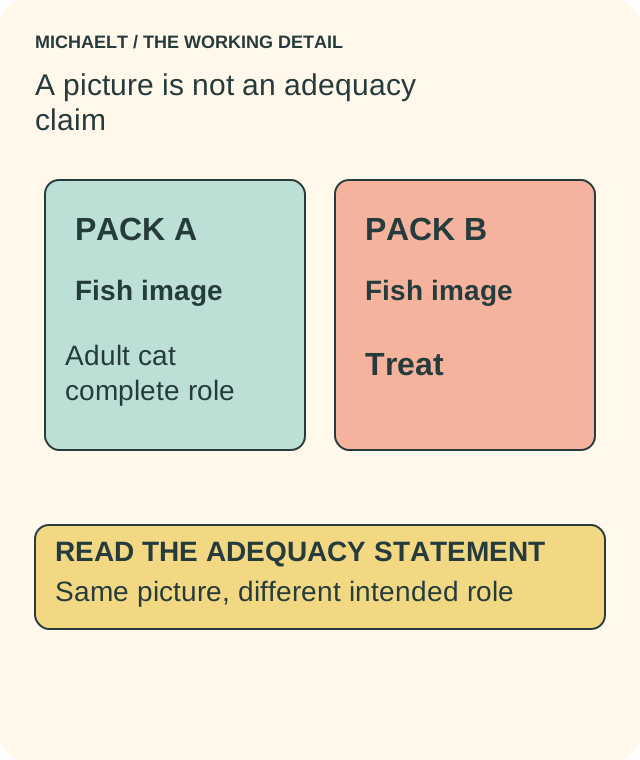
Two fictional packs show fish. One declares a complete-and-balanced adult-cat role; the other is a treat. Read species, life stage and intended role on the actual label.
Work through an example
Fictional bag A states a complete-and-balanced role for adult cats. Pack B is labelled as a treat. Their front panels both display a fish image, but the comparison records different intended roles rather than treating them as interchangeable meals. The owner leaves suitability for the actual cat to a veterinary discussion.
Illustrative example; figures, people and organisations in the worked record are fictional.
The example record
Species / stage
- Fictional A
- Adult cats stated
- Fictional B
- Read actual statement
Intended role
- Fictional A
- Complete-and-balanced statement
- Fictional B
- Treat
Front image
- Fictional A
- Fish image
- Fictional B
- Fish image
Conclusion
- Fictional A
- Different declared roles
- Fictional B
- Image is not adequacy evidence
Download blank worksheet (.csv) ↗Download worked example (.csv) ↗
Keep your own record
Use the result within its scope
Use the actual label and qualified advice for the individual animal. This is a label-reading procedure, not a feeding prescription, allergy test, diet ranking or endorsement of a manufacturer.