Identify the actual game and build
Record the title, version, platform and input device. The linked EA F1 22 assist page is a historical example for that game and platform, not a claim that every 2026 menu has the same settings. Use the current game’s own instructions and accessibility information for the actual session. Do not carry an old article’s control labels into a different title without checking.
Choose one question
Pick a concrete in-game task, such as learning how one assist changes the experience of a familiar practice section. Record the track or scenario, game mode and relevant existing settings. Keep the question about the game. A faster lap, controller skill or simulated manoeuvre does not demonstrate safe driving on a public road or meet licensing requirements.
Change one setting and record the rest
Use only the game’s normal supported controls and retain a route back to the earlier setting. Keep the input device, scenario and other relevant options consistent where possible. Record subjective observations separately from game-reported numbers. Several simultaneous changes make it difficult to tell which one mattered. Do not claim an improvement was measured if the record contains only a preference.
Choose the more usable arrangement
Review whether the change made the game easier to understand or more comfortable to play. An accessibility option is a legitimate choice, not a failure. Record the final preference and unresolved questions without inventing a universal best setup. This worksheet does not install modifications, bypass anti-cheat systems or submit scores and personal data to a service.
Read the drawing as text
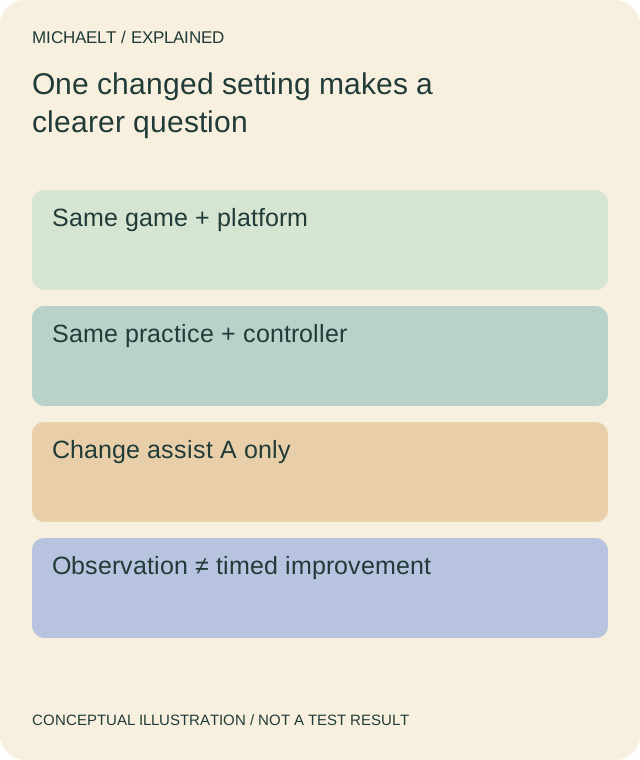
Keeping the scenario and controller consistent makes one assist change easier to discuss. A preference is not a measured gain or driving competence.
Work through an example
A fictional player repeats one practice section with the same controller and changes only assist A. The note says the second setup felt easier to understand, but no timing data was collected. The record therefore reports a preference rather than a measured lap-time gain or a claim of improved real-world driving.
Illustrative example; figures, people and organisations in the worked record are fictional.
The example record
Game/platform
- Baseline
- Exact actual version
- Comparison
- Same
Scenario/input
- Baseline
- Practice S / controller C
- Comparison
- Same
Assist A
- Baseline
- Original setting recorded
- Comparison
- One supported change
Outcome
- Baseline
- No timing collected
- Comparison
- Preference only
Download blank worksheet (.csv) ↗Download worked example (.csv) ↗
Keep your own record
Use the result within its scope
Use the actual game’s instructions and accessibility controls. This is an in-game comparison exercise, not a driving lesson or a performance benchmark.
Reference sources
Earlier articles on this subject
- Can Video Games Teach Us To Drive? ↗ — 2022-02-22, Maria Baldwin.