Read the actual session’s price route
Find the operator’s current information for the actual location and plan. For example, Electrify America directs drivers to its app or charger screen for current pricing and notes possible idle fees. Do not treat a price saved from another station, plan or date as the current offer. Keep the timestamp and the actual stated charging basis with the comparison.
Separate kW from kWh
Power in kilowatts describes a rate; energy in kilowatt-hours describes a quantity. A headline charger power is not the amount of energy your vehicle will receive or a promised duration. Record the unit of the tariff exactly. A per-minute price and a per-kWh price need different inputs for a cost illustration. Ask the operator about any unexplained unit rather than replacing it with a guess.
Itemise conditions and additional charges
Check session charges, plan or subscription terms, time-related charges, parking and other applicable amounts in the actual information. Do not assume an operator or car park includes every cost in the energy price. Compatibility, connector, access, payment route and availability also need checking for the actual vehicle and journey. This document gives no instructions for installing or modifying charging equipment.
Keep an estimate separate from a receipt
Use stated assumptions for any calculation and reconcile against the actual session receipt when one exists. A hypothetical 20 kWh at a fixed 0.40 units/kWh is 8 units before any separately applicable charges. It is not proof that a vehicle needs 20 kWh, achieves a certain range or receives that energy at the charger’s advertised maximum power. An estimate cannot reserve a charging bay.
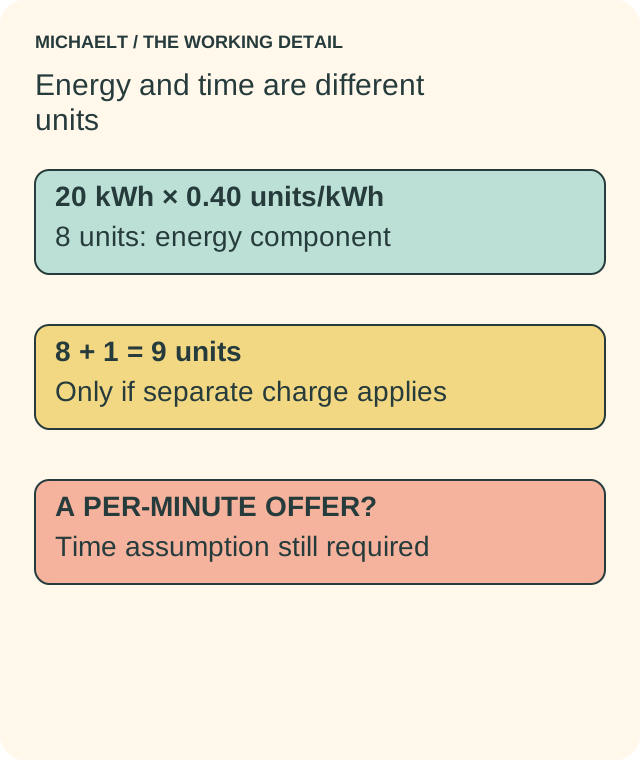
Read the drawing as text
Illustrative 20 kWh at 0.40 units/kWh gives 8 units. A separately applicable 1-unit charge makes 9. A per-minute offer cannot be compared without a time assumption.
Work through an example
Fictional tariff A is 0.40 units/kWh and a hypothetical session receives 20 kWh: the energy component is 8 units. A separate hypothetical idle charge of 1 unit would make those two components 9 units, if applicable. Fictional tariff B is priced per minute, so it cannot be compared without an explicit time assumption. These are not current operator prices.
Illustrative example; figures, people and organisations in the worked record are fictional.
The example record
Energy tariff
- Illustrative amount
- 0.40 units/kWh
- Result or limit
- Not a kW power value
Energy received
- Illustrative amount
- 20 kWh
- Result or limit
- Energy component: 8 units
Separate applicable charge
- Illustrative amount
- 1 unit
- Result or limit
- Illustrated subtotal: 9 units
Time-based alternative
- Illustrative amount
- Minutes unknown
- Result or limit
- No invented comparison
Download blank worksheet (.csv) ↗Download worked example (.csv) ↗
Keep your own record
Use the result within its scope
Use the operator’s current terms and the vehicle maker’s information for an actual journey. No charging equipment, payment, compatibility, power delivery or driving range is tested or guaranteed by this worksheet.
Reference sources
- US DOE AFDC: charging infrastructure operation and maintenance ↗
- Electrify America: current pricing route ↗